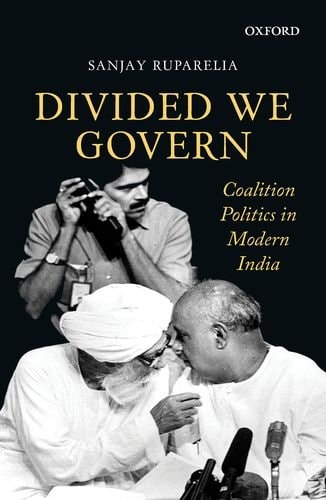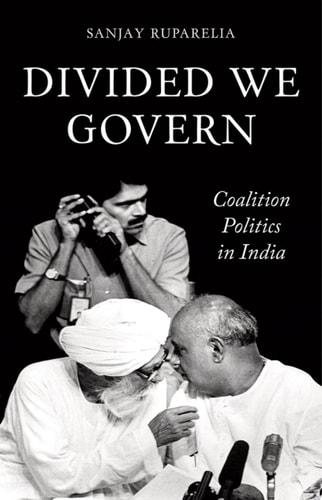
Divided We Govern: Coalition Politics in Modern India
0
0
As an Amazon Associate and affiliate partner, Menrva Books earns from qualifying purchases. Learn more
Author Description
Divided We Govern investigates the rise and fall of the broader parliamentary left in modern Indian democracy, and the dynamics of national coalition governments. Since the 1970s, socialist, communist and regional parties in India have sought to forge a progressive 'third force'. Most scholars typically dismiss its principal manifestations -- the Janata Party, National Front and United Front -- as inherently opportunistic coalitions of power-seeking politicians. Sanjay Ruparelia provides a fine-grained analytic narrative to challenge this prevailing wisdom. Employing a variety of methods and resources, including the rare confidential testimonies of key political actors, Ruparelia demonstrates how the politics of each governing coalition, despite their self-evident flaws and short-lived tenures, revealed the outlines of a distinctive national vision. His fresh analysis of the politics of coalition in India also yields wider theoretical insights. Most studies fail to question or explain how these multiparty governments actually functioned. Hence they overstate the stability of and polarity between multiple political motivations, Ruparelia contends, discounting internal party debates over whether to share power, with whom and to what extent, and how. In such circumstances, the strategies, tactics and choices of actors become especially significant. The pursuit of power in a highly regionalized federal parliamentary democracy such as India creates incentives to forge national coalition governments, yet paradoxically decreases their chances of surviving. Ultimately, the failure of socialists and communists to judge their real historical possibilities at key junctures led to the decline of the broader Indian left.
Menrva's Summary
THE THESIS
This book investigates the rise and decline of the parliamentary left in India by analyzing the internal dynamics and national visions of various coalition governments since the 1970s. Sanjay Ruparelia, a political scientist, challenges the conventional view that these coalitions were merely opportunistic alliances. By utilizing confidential testimonies and detailed political analysis, he argues that these governments represented a distinct, albeit flawed, attempt to construct a progressive national alternative within a complex federal democracy.
THE SCOPE MAP
What You Will Find
- Analysis of the Janata Party, National Front, and United Front coalitions.
- Examination of internal party debates regarding power-sharing strategies.
- Theoretical framework for understanding multiparty governance in regionalized federal systems.
Scope Limits
- The study focuses primarily on the parliamentary left and does not provide an exhaustive history of all Indian political parties.
- The analysis is restricted to the period from the 1970s through the decline of the broader left.
THE AUTHORITY PERSPECTIVE
Scholars and political analysts recognize this work as a significant contribution to the study of Indian democratic institutions and coalition governance. Readers frequently note the academic density of the prose and the depth of the primary source material used to challenge established political narratives.
Page Count:
480
Publication Date:
2015-01-01
Publisher:
Oxford University Press
ISBN-10:
019061336X
ISBN-13:
9780190613365
History
India
Communism
Government
Coalition Politics
American Government
Socialism