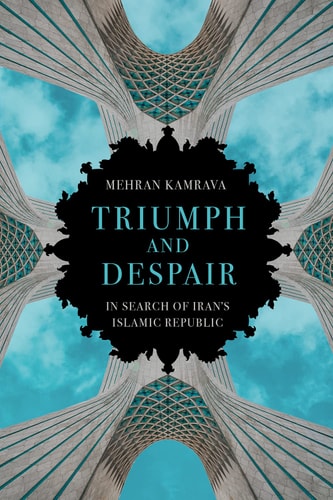
Triumph and Despair: In Search of Iran's Islamic Republic
0
0
As an Amazon Associate and affiliate partner, Menrva Books earns from qualifying purchases. Learn more
Author Description
Triumph and Despair tells the dramatic story of post-revolutionary Iran's first four decades, from its establishment in 1979 until today. The revolutionary coalition that overthrew the monarchy was at once democratic, populist and Islamic. The Islamists, and the Khomeinists in particular, were able to capitalize effectively on prevailing conditions on the ground; to frame the new republic's constitution, capture nascent institutions, and consolidate their power by eliminating opponents through a reign of terror. Once the war with Iraq was over and after the death of the new order's charismatic founder, Ayatollah Khomeini, the Islamic Republic was consolidated: first by tweaking its institutional arrangements, and then by fostering economic development and post-war reconstruction. A reformist interlude then followed, reversed unceremoniously by a return of populism and a broader authoritarian retrenchment. Today Iran remains at odds with itself, its economy too deeply political to yield meaningful developmental results, its foreign relations too conflicted to allow it a productive place in the community of nations. As Iran's nationalities and its women and youth carve out spaces for themselves in the broader narrative, competing identities-religious, national and otherwise-abound. After forty years, the Islamic Republic remains a country in search of itself.
Menrva's Summary
THE THESIS
This work investigates the political trajectory of Iran from the 1979 revolution to the present, questioning how a diverse revolutionary coalition transformed into a consolidated, yet internally conflicted, Islamic Republic. Mehran Kamrava, a scholar of Middle Eastern politics, utilizes historical analysis and political theory to examine the mechanisms of power consolidation, institutional development, and the subsequent cycles of reform and authoritarian retrenchment. The text argues that the state's current developmental and diplomatic stagnation is a direct result of the deep entanglement between political ideology and economic structure.
THE SCOPE MAP
What You Will Find
- A chronological analysis of Iran's political evolution across four decades.
- Examination of the institutional consolidation strategies employed by the Khomeinist faction.
- Assessment of the impact of the Iran-Iraq war on domestic governance and state-building.
- Analysis of the competing social identities, including the roles of youth, women, and various nationalities within the state.
THE AUTHORITY PERSPECTIVE
Experts recognize this text as a comprehensive political history that clarifies the complex internal dynamics of the Iranian state. Readers frequently note the clarity of the author's prose in navigating the dense institutional and ideological shifts of the post-revolutionary era.
Page Count:
304
Publication Date:
2023-01-01
Publisher:
Oxford University Press
ISBN-10:
0197678416
ISBN-13:
9780197678411
History
International relations
Government
Middle East
Community Tags
Similar Books