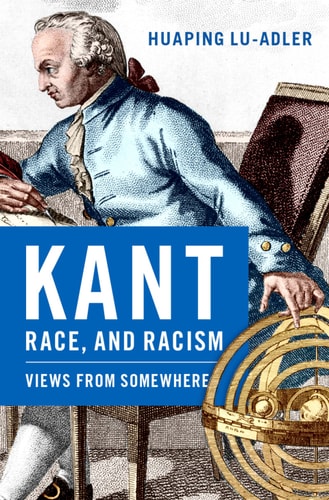
Kant, Race, and Racism: Views from Somewhere
0
0
As an Amazon Associate and affiliate partner, Menrva Books earns from qualifying purchases. Learn more
Author Description
Kant scholars have paid relatively little attention to his raciology. They assume that his racism, as personal prejudice, can be disentangled from his core philosophy. They also assume that racism contradicts his moral theory. In this book, philosopher Huaping Lu-Adler challenges both assumptions. She shows how Kant's raciology--divided into racialism and racism--is integral to his philosophical system. She also rejects the individualistic approach to Kant and racism. Instead, she uses the notion of racism as ideological formation to demonstrate how Kant, from his social location both as a prominent scholar and as a lifelong educator, participated in the formation of modern racist ideology. As a scholar, Kant developed a ground-breaking scientific theory of race from the standpoint of a philosophical investigator of nature or Naturforscher. As an educator, he transmitted denigrating depictions of the racialized others and imbued those descriptions with normative relevance. In both roles, he left behind, as one of his legacies, a worldview that excluded non-whites from such goods as recognitional respect and candidacy for cultural and moral achievements. Scholars who research and teach Kant's philosophy therefore have an unshakable burden to take part in the ongoing antiracist struggles, through their teaching practices as well as their scholarship. And they must do so with a pragmatic attention to nonideal social realities and a deliberate orientation toward substantial racial justice, equality, and inclusion. Lu-Adler pushes the discourse about Kant and racism well beyond the old debates about whether he was racist or whether his racism contaminates his philosophy. By foregrounding the lasting legacies of Kant's raciology, her work calls for a profound reorientation of Kant scholarship.
Menrva's Summary
THE THESIS
This book investigates the extent to which Immanuel Kant's racial theories are inextricably linked to his core philosophical system rather than being mere personal prejudices. Philosopher Huaping Lu-Adler argues that Kant's raciology, categorized into racialism and racism, functions as an ideological formation that shaped modern racist thought. By examining Kant's dual roles as a scientific investigator of nature and a lifelong educator, Lu-Adler demonstrates how he institutionalized exclusionary worldviews. The work challenges the traditional scholarly tendency to isolate Kant's moral theory from his racial views, asserting that his legacy necessitates a reevaluation of how his philosophy is taught and researched today.
THE SCOPE MAP
What You Will Find
- Analysis of Kant's scientific theories of race developed in his capacity as a Naturforscher.
- Examination of Kant's pedagogical influence in transmitting denigrating depictions of racialized groups.
- Critique of the individualistic approach to analyzing racism within philosophical texts.
- Framework for integrating antiracist practices into contemporary Kantian scholarship and teaching.
THE AUTHORITY PERSPECTIVE
Experts recognize this work as a significant intervention in Kantian studies that shifts the focus from individual moral culpability to the systemic ideological impact of his philosophy. Readers frequently note the rigorous academic density of the prose and its call for a structural reorientation of how the philosopher's legacy is handled in modern academia.
Page Count:
417
Publication Date:
2023-01-01
Publisher:
Oxford University Press
ISBN-10:
0197685226
ISBN-13:
9780197685228
Philosophy
Politics
Social Theory
Ethics
History & Schools of Thought
Race Studies
Community Tags
Similar Books