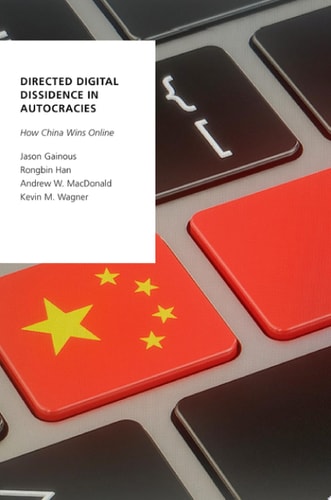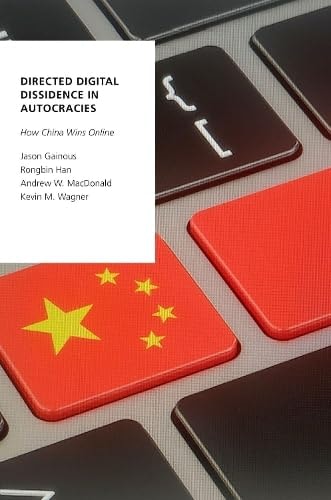
Directed Digital Dissidence in Autocracies: How China Wins Online
0
0
As an Amazon Associate and affiliate partner, Menrva Books earns from qualifying purchases. Learn more
Author Description
In This Book, We Use The Case Of China To Examine How State Actors Can Transform The Internet And Online Discourse Into A Key Strategic Element For Maintaining The Government And Relieving Domestic Pressure On National Institutions. While Scholars Have Long Known That The Democratizing Influence Of The Internet Can Be Blunted By Autocratic States, In This Book, We Show That The Online Sphere Can Effectively Be Co-opted By States Like China And Transformed Into A Supporting Institution. Our Theory, Directed Digital Dissidence, Explains How Autocracies Manage Critical Online Information Flows And The Impact This Management Has On Mass Opinion And Behavior. While The Expansion Of The Internet May Stimulate Dissidence, It Also Provides The Central Government An Avenue To Direct That Dissent Away And Toward Selected Targets. Under The Strategy Of Directed Digital Dissidence, The Internet Becomes A Mechanism To Dissipate Threats By Serving As A Targeted Relief Valve Rather Than A Building Pressure Cooker. We Consider The Process And Impact Of This Evolving State Led Manipulation Of The Political Internet Using Data And Examples From China. We Use An Original Large-scale Random Survey Of Chinese Citizens To Measure Internet Use, Social Media Use, And Political Attitudes. We Also Consider The Impact Of The State Firewall. Beyond Simply Identifying The Government Strategy, We Focus On Testing The Effectiveness Of The Strategy With Empirical Data. We Also Consider How The Redirection Of Dissent Can Be Done Across A Broader Range Of Targets, Including Non-state Actors And Other Nations-- Provided By Publisher.
Menrva's Summary
THE THESIS
This book investigates how autocratic regimes, specifically China, strategically manipulate online discourse to neutralize domestic threats and maintain institutional stability. The authors, a multidisciplinary team of political scientists and social science experts, argue that the internet is not inherently democratizing but can be co-opted as a state-controlled mechanism. By introducing the theory of 'Directed Digital Dissidence,' they explain how governments redirect public frustration toward specific, state-approved targets, effectively turning the digital sphere into a relief valve rather than a catalyst for revolution.
THE SCOPE MAP
What You Will Find
- A comprehensive analysis of the 'Directed Digital Dissidence' framework and its application in modern autocracies.
- Empirical findings derived from a large-scale, original random survey of Chinese citizens regarding their social media habits and political attitudes.
- An examination of the technical and social impact of the state-led firewall on information flow.
- Quantitative and qualitative evidence assessing the effectiveness of state-led manipulation strategies against non-state actors and foreign nations.
THE AUTHORITY PERSPECTIVE
Experts highlight this work as a significant contribution to the study of digital authoritarianism, noting its rigorous empirical approach to a complex, opaque subject. Readers frequently observe that the text provides a clear, data-driven methodology that moves beyond theoretical speculation to demonstrate how modern states actively manage digital dissent.
Page Count:
184
Publication Date:
2023-01-01
Publisher:
Oxford University Press, USA
ISBN-10:
0197680399
ISBN-13:
9780197680391
International relations
Technology and Society
Communication
China Studies
Sociology
Community Tags
Similar Books