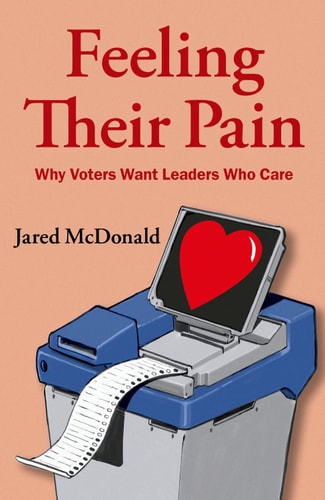
Feeling Their Pain: Why Voters Want Leaders Who Care
0
0
As an Amazon Associate and affiliate partner, Menrva Books earns from qualifying purchases. Learn more
Author Description
The 2020 Presidential Election in the United States marked, for many, a return to "compassionate politics." Joe Biden had run on a platform of empathy, emphasizing his personal history as a means of connecting with everyone from American workers who had lost jobs to military families who had lost loved ones. Although perceptions of candidate compassion are broadly understood to influence vote choice, less understood is the question of how candidates convince voters they truly "care about people like them." In Feeling their Pain: Why Voters want Leaders who Care, Jared McDonald provides a framework for understanding why voters view some politicians as more compassionate than others.McDonald shows that perceptions of compassion in candidates for public office are based on the number and intensity of commonalities that bind citizens to political leaders. Commonalities can come in many forms, such as a shared experience ("I've been through what you've been through"), a shared emotion ("I feel the way you feel"), or a shared identity ("I am who you are"). Compassion is conceptualized through the lens of self-interest. Compassion may be universal, such as when candidates convey empathy to all individuals who are struggling. Or compassion may be exclusionary, such as when candidates express a preference for some groups over others. Thus, the way campaigns choose to wield compassion in their messaging strategies has important implications not only for election outcomes, but for American political polarization as well.
Menrva's Summary
THE THESIS
This book investigates the mechanisms by which political candidates cultivate perceptions of compassion to influence voter behavior and election outcomes. Jared McDonald, a scholar of political communication, utilizes data from the 2020 U.S. Presidential Election to analyze how empathy functions as a strategic tool in modern campaigning. He argues that voters evaluate candidate compassion based on perceived commonalities, which can be categorized as shared experiences, emotions, or identities. The work posits that the strategic deployment of these perceptions significantly impacts both electoral success and the broader trajectory of American political polarization.
THE SCOPE MAP
What You Will Find
- Analysis of the 2020 U.S. Presidential Election as a case study for compassionate politics.
- A theoretical framework categorizing compassion into universal versus exclusionary messaging strategies.
- Examination of how shared experiences, emotions, and identities bind citizens to political leaders.
- Discussion on the relationship between campaign messaging strategies and national political polarization.
THE AUTHORITY PERSPECTIVE
Experts identify this work as a significant contribution to the study of political psychology and voter behavior. Readers frequently note the clarity of the author's framework, which provides a structured approach to understanding the often-subjective nature of political empathy.
Page Count:
200
Publication Date:
2023-01-01
Publisher:
Oxford University Press
ISBN-10:
0197696902
ISBN-13:
9780197696903
Politics
American Politics
Schools & Teaching
Sociology
Elections & Political Process
Elections
Political Psychology
Community Tags
Similar Books