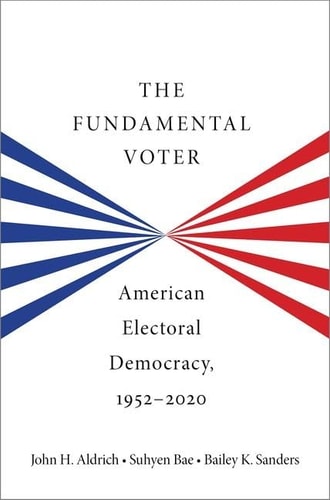
The Fundamental Voter: American Electoral Democracy, 1952-2020
0
0
As an Amazon Associate and affiliate partner, Menrva Books earns from qualifying purchases. Learn more
Author Description
Why is American politics so intense and emotionally competitive today, and how did we get here? In The Fundamental Voter, John H. Aldrich, Suhyen Bae, and Bailey K. Sanders explain why the notion that we are divided into tribal loyalties is, at best, only partially correct, and discuss how the divisions rest on much more substantive politics than they once did.In the 1950s and 1960s, the American public based voting primarily on partisan loyalties. Landslide presidential elections were once common, but over the last forty years, they have converged to very closely contested elections. Congressional elections were increasingly incumbent centered before 1984 and decreasingly so afterward. These changes reflect the changing nature of fundamental forces that shape the public's electoral opinions and voting behavior. From a single such fundamental, partisan identification, the electorate now rests on five fundamental forces: party, ideology, issues, race, and economics.Since the 1980s, these fundamentals have grown increasingly important and increasingly aligned, such that voters are now sorted into two increasingly bitterly divided sides. Believing that the other side is on the wrong side of nearly everything of political relevance, voters, like officials, have come to deeply dislike the opposition, a state of affairs that threatens to undermine the stability of democratic institutions in the United States.
Menrva's Summary
THE THESIS
This book investigates the evolution of American electoral behavior from the 1950s to 2020 to determine why contemporary politics has become increasingly polarized and emotionally charged. The authors, John H. Aldrich, Bailey K. Sanders, and Suhyen Bae, utilize longitudinal data to argue that the electorate has shifted from a single-factor model of partisan loyalty to a complex, five-factor framework. By analyzing party, ideology, issues, race, and economics, the authors demonstrate how these forces have aligned to create a deeply divided political landscape that challenges the stability of democratic institutions.
THE SCOPE MAP
What You Will Find
- Longitudinal analysis of American presidential and congressional election data from 1952 to 2020.
- A five-factor theoretical framework explaining the drivers of modern voter behavior.
- Quantitative evidence illustrating the transition from incumbent-centered congressional elections to party-centered contests.
- Examination of the relationship between voter sorting and the erosion of institutional stability.
THE AUTHORITY PERSPECTIVE
Political scientists view this work as a rigorous empirical update to the study of American electoral behavior. The text is noted for its clear synthesis of complex data sets, making it a valuable resource for scholars and students interested in the structural causes of modern political polarization.
Page Count:
192
Publication Date:
2024-01-01
Publisher:
Oxford University Press
ISBN-10:
0197745490
ISBN-13:
9780197745496
Politics
History
American Politics
Sociology
Elections & Political Process
Elections
Community Tags
Similar Books