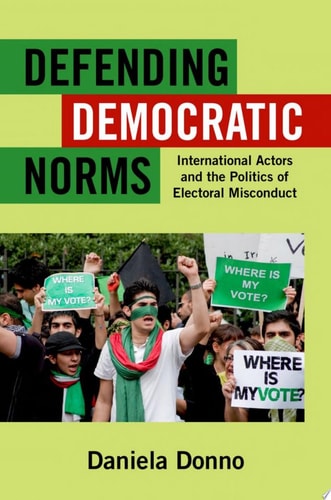
Defending Democratic Norms: International Actors and the Politics of Electoral Misconduct
0
0
As an Amazon Associate and affiliate partner, Menrva Books earns from qualifying purchases. Learn more
Author Description
Although nearly every country in the world today holds multiparty elections, these contests are often blatantly unfair. For governments, electoral misconduct is a tempting but also a risky practice, because it represents a violation of international standards for free and fair elections. In Defending Democratic Norms, Daniela Donno examines how international actors respond to these norm violations. Which governments are punished for manipulating elections? Does international norm enforcement make a difference? Donno shows that although enforcement is selective and relatively rare, when international actors do employ tools of conditionality, diplomacy, mediation and shaming in response to electoral misconduct, they can have transformative effects on both the quality and outcome of elections. Specifically, enforcement works by empowering the domestic opposition and increasing the government's incentives to reform institutions of electoral management and oversight. These effects depend, however, on the presence of a viable opposition movement, as well as on the strength and credibility of the enforcement effort itself. The book shows that regional international organizations possess unique sources of leverage and legitimacy that make them the most consistently effective norm defenders, even compared to more materially powerful actors like the United States. Drawing on an original dataset from almost 700 elections and incorporating case studies from the Dominican Republic, Serbia, Armenia, Kenya and Cambodia, Defending Democratic Norms is a bold new theory of international norm enforcement that demonstrates the importance of active international intervention in domestic politics.
Menrva's Summary
THE THESIS
This book investigates the conditions under which international actors effectively enforce democratic norms in response to electoral misconduct. Daniela Donno, a scholar of international relations and comparative politics, utilizes a comprehensive dataset of nearly 700 elections alongside qualitative case studies to analyze the efficacy of international intervention. The author argues that while enforcement is often selective, strategic tools such as conditionality, diplomacy, and shaming can significantly alter the trajectory of domestic political contests when paired with a viable opposition movement.
THE SCOPE MAP
What You Will Find
- A quantitative analysis of electoral misconduct across nearly 700 global elections.
- Comparative case studies focusing on the Dominican Republic, Serbia, Armenia, Kenya, and Cambodia.
- An evaluation of the comparative leverage held by regional international organizations versus individual powerful states.
- A theoretical framework detailing how international pressure empowers domestic opposition and incentivizes institutional reform.
THE AUTHORITY PERSPECTIVE
Experts in international relations identify this work as a rigorous empirical contribution to the study of norm enforcement and democratic backsliding. Readers frequently note the academic density of the prose, which provides a systematic, data-driven approach to understanding the complexities of international political intervention.
Page Count:
282
Publication Date:
2013-01-01
Publisher:
Oxford University Press
ISBN-10:
0199361134
ISBN-13:
9780199361137
Politics
Kindle Store
Democracy
Systems Theory
Elections
International relations
Human rights
Categories
Comparative Government
Kindle eBooks
Public Policy
Elections & Political Process
World politics
Community Tags
Other Editions(2)

Similar Books