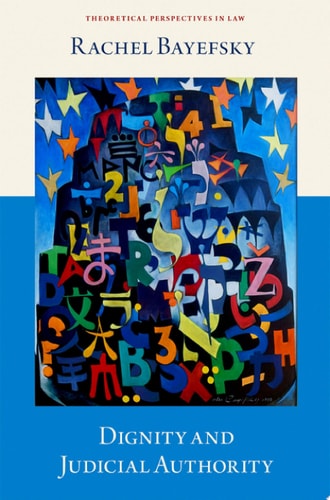
Dignity and Judicial Authority: Theoretical Perspectives in Law
0
0
As an Amazon Associate and affiliate partner, Menrva Books earns from qualifying purchases. Learn more
Author Description
Human rights movements and organizations all over the world cite the pursuit and preservation of dignity as one of their goals, but the legal implications of this term are highly contested. In Dignity and Judicial Authority, Rachel Bayefsky offers a theory of dignity that emphasizes respect for status, non-domination, and control over self-presentation to others. The book explains how US courts can recognize the loss of dignity as a legally actionable harm and provide remedies for this harm. In applying these ideas, the book explores a host of corresponding legal topics, including constitutional standing doctrine, the “dignitary torts,” and court-mandated apologies. It demonstrates the connections between dignity and subjects such as jurisdiction and remedies, which help to delineate the bounds of judicial authority.This inquiry sheds light not only on the nature of dignity, but also on the power of courts and their proper functions in a constitutional democracy. How can judges decide whether dignity has been violated, especially when these decisions risk embroiling them in contentious social disputes? Will accepting dignitary claims burst open the proverbial “floodgates of litigation”? Through theoretical analysis and detailed doctrinal discussion, Bayefsky explains how courts can integrate dignity into legal determinations in a thoughtful and principled manner.Exploring the subject from theoretical and practical perspectives, Dignity and Judicial Authority presents a cogent argument for when and how courts should use their powers to protect and preserve human dignity.
Menrva's Summary
THE THESIS
How can the legal system effectively recognize and remedy violations of human dignity without overstepping the bounds of judicial authority? Rachel Bayefsky, a scholar of legal theory, investigates the conceptual ambiguity surrounding dignity in human rights discourse. She proposes a framework centered on status, non-domination, and self-presentation to provide a principled basis for courts to address dignitary harms within a constitutional democracy.
THE SCOPE MAP
What You Will Find
- A theoretical framework defining dignity through the lenses of status and non-domination.
- Analysis of US constitutional standing doctrine and its relationship to dignitary claims.
- Examination of specific legal mechanisms including dignitary torts and court-mandated apologies.
- Discussion on the institutional role of the judiciary in navigating contentious social disputes.
THE AUTHORITY PERSPECTIVE
Legal scholars and practitioners identify this work as a significant contribution to the intersection of jurisprudence and human rights theory. The text is noted for its balance of abstract philosophical inquiry and practical doctrinal application, making it a useful resource for those studying the limits of judicial power.
Page Count:
208
Publication Date:
2024-10-11
Publisher:
Oxford University Press
ISBN-10:
019775032X
ISBN-13:
9780197750322
Jurisprudence
Human rights
Systems Theory
Legal Theory
Constitutional Law
Law
Community Tags
Similar Books