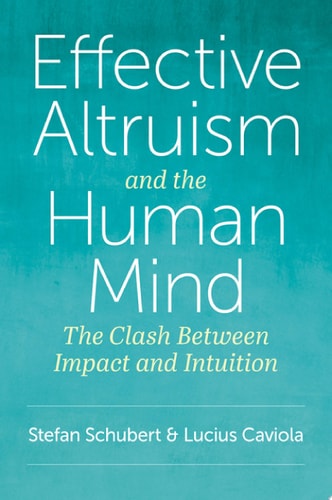
Effective Altruism and the Human Mind: The Clash Between Impact and Intuition
0
0
As an Amazon Associate and affiliate partner, Menrva Books earns from qualifying purchases. Learn more
Author Description
Each year, people donate billions to charities that are but a fraction as impactful as the most effective charities. Why is that? Why are people not helping others more effectively, as proposed by effective altruism? This book seeks to give a psychological explanation, drawing on decades of empirical research. It investigates the role of preferences, norms, and beliefs and shows how intuition can limit impact. The second part of the book shows how we can overcome these obstacles through information campaigns, incentivization techniques, and fundamental value change. It ends with a discussion of how we can use psychology to apply effective altruism in everyday life.This is an open access title available under the terms of a CC BY-NC-ND 4.0 license. It is free to read at Oxford Scholarship Online and offered as a free PDF download from OUP and selected open access locations.
Menrva's Summary
THE THESIS
This book investigates the psychological barriers that prevent individuals from maximizing the impact of their charitable giving and altruistic efforts. Authors Lucius Caviola and Stefan Schubert utilize decades of empirical psychological research to analyze why human intuition often conflicts with the data-driven principles of effective altruism. The text provides a framework for understanding how cognitive biases, social norms, and personal beliefs shape donation behavior, ultimately proposing strategies to align human decision-making with more effective outcomes.
THE SCOPE MAP
What You Will Find
- Analysis of cognitive biases and intuitive heuristics that hinder rational altruism.
- Examination of social norms and belief systems influencing charitable preferences.
- Evidence-based strategies for overcoming psychological obstacles to effective giving.
- Practical applications of behavioral science to improve everyday altruistic decision-making.
THE AUTHORITY PERSPECTIVE
Experts recognize this work as a significant contribution to the intersection of behavioral economics and moral philosophy. Readers frequently note the clarity of the prose and the accessibility of the empirical data presented for both academic and general audiences.
Page Count:
192
Publication Date:
2024-01-01
Publisher:
Oxford University Press
ISBN-10:
0197757375
ISBN-13:
9780197757376
Psychology
Philosophy
Non-Fiction
Personality
Social Science
Ethics
Counseling Psychology
Community Tags
Similar Books