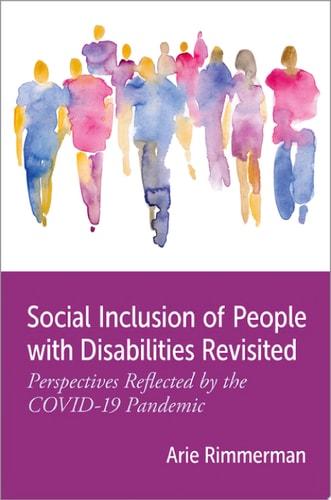
Social Inclusion of People with Disabilities Revisited: Perspectives Reflected by the COVID-19 Pandemic
0
0
As an Amazon Associate and affiliate partner, Menrva Books earns from qualifying purchases. Learn more
Author Description
Two recent developments created a need for this book, the first is the ratification of the United Nation's Convention on the Rights of Persons with Disabilities (CRPD) in most of the countries. The convention clarifies the provisions of their social inclusion and rights for assistive technologies. The second development is the COVID-19 pandemic that has disrupted the lives of people around the world, and particularly people with disabilities. The restrictions imposed on the general public to save lives worsened the conditions of people with disabilities who experienced further deterioration of health outcomes, social exclusion, and discrimination. Social inclusion has changed during the COVID-19 pandemic as digital substantially replaced face-to-face communication.The digitalization has changed society and reconfigures social relationships, and thus the dynamics and climate of inclusion. Can digital inclusion compensate persons with disabilities for their social exclusion in virtual reality? The book discusses whether the pandemic changes the status of social inclusion of persons with disabilities. The book explores the roots of social inclusion/exclusion and current use of the term in respect to people with disabilities, the impact of COVID-19 on social inclusion of people with disabilities, and countries' policies to them during the pandemic and afterward. The core issue is regarding relationship between social and digital inclusion during the pandemic and afterward. This has been discussed in respect to persons with various disabilities living in developed and low-medium-income countries and children with disabilities.
Menrva's Summary
THE THESIS
This book investigates whether the rapid shift toward digital communication during the COVID-19 pandemic has effectively mitigated or exacerbated the social exclusion experienced by persons with disabilities. Arie Rimmerman, a scholar in the field of disability studies, utilizes the framework of the United Nations Convention on the Rights of Persons with Disabilities (CRPD) to evaluate how global policy responses to the pandemic impacted the rights and inclusion of disabled populations. By analyzing the intersection of physical isolation and digital reliance, the author assesses whether virtual environments provide a viable pathway for social integration or if they create new barriers to accessibility and equity.
THE SCOPE MAP
What You Will Find
- Comparative analysis of social inclusion policies across developed and low-to-medium-income countries.
- Examination of the relationship between digital accessibility and traditional social participation.
- Evaluation of the impact of pandemic-era restrictions on health outcomes and discrimination for disabled individuals.
- Discussion of the specific challenges faced by children with disabilities in a digitized social landscape.
THE AUTHORITY PERSPECTIVE
Experts identify this work as a critical contribution to the evolving discourse on disability rights in the post-pandemic era. Readers frequently note the academic rigor with which the author connects international policy frameworks to the practical realities of digital exclusion.
Page Count:
192
Publication Date:
2024-11-19
Publisher:
Oxford University Press
ISBN-10:
0197758908
ISBN-13:
9780197758908
Politics
Social Science
Public Health
Public Policy
Sociology
Community Tags
Similar Books