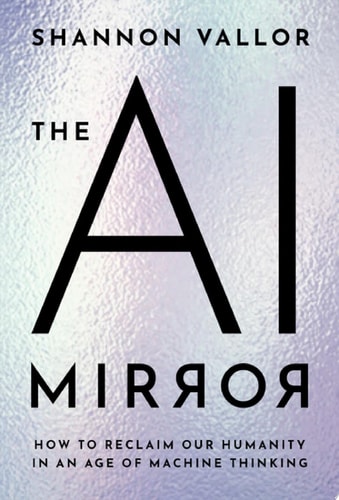
The AI Mirror: How to Reclaim Our Humanity in an Age of Machine Thinking
0
0
As an Amazon Associate and affiliate partner, Menrva Books earns from qualifying purchases. Learn more
Author Description
For many, technology offers hope for the future―that promise of shared human flourishing and liberation that always seems to elude our species. Artificial intelligence (AI) technologies spark this hope in a particular way. They promise a future in which human limits and frailties are finally overcome―not by us, but by our machines.Yet rather than open new futures, today's powerful AI technologies reproduce the past. Forged from oceans of our data into immensely powerful but flawed mirrors, they reflect the same errors, biases, and failures of wisdom that we strive to escape. Our new digital mirrors point backward. They show only where the data say that we have already been, never where we might venture together for the first time.To meet today's grave challenges to our species and our planet, we will need something new from AI, and from ourselves.Shannon Vallor makes a wide-ranging, prophetic, and philosophical case for what AI could be: a way to reclaim our human potential for moral and intellectual growth, rather than lose ourselves in mirrors of the past. Rejecting prophecies of doom, she encourages us to pursue technology that helps us recover our sense of the possible, and with it the confidence and courage to repair a broken world. Vallor calls us to rethink what AI is and can be, and what we want to be with it.
Menrva's Summary
THE THESIS
This book investigates how artificial intelligence can be redirected from a tool that reinforces historical biases to a mechanism that fosters human moral and intellectual growth. Shannon Vallor, a philosopher of technology, utilizes a framework rooted in ethics and social theory to critique the current trajectory of machine learning. She argues that by treating AI as a mirror of our past data, we limit our potential, and she proposes a shift toward technologies that support human agency and collective problem-solving.
THE SCOPE MAP
What You Will Find
- Analysis of how current AI models perpetuate historical data biases and systemic errors.
- Philosophical arguments regarding the intersection of human flourishing and machine autonomy.
- A critique of technological determinism and the narrative of AI as an inevitable replacement for human judgment.
- Proposed strategies for developing AI that encourages moral development and creative problem-solving.
THE AUTHORITY PERSPECTIVE
Experts in the field of AI ethics recognize this work as a significant contribution to the discourse on human-centric technology design. Readers frequently note the accessible yet rigorous philosophical approach Vallor takes when addressing complex technical and societal challenges.
Page Count:
256
Publication Date:
2024-01-01
Publisher:
Oxford University Press
ISBN-10:
0197759068
ISBN-13:
9780197759066
Politics
Philosophy
Manufacturing Systems
Sociology
Ethics & Morality
Engineering
Ethics
Technology