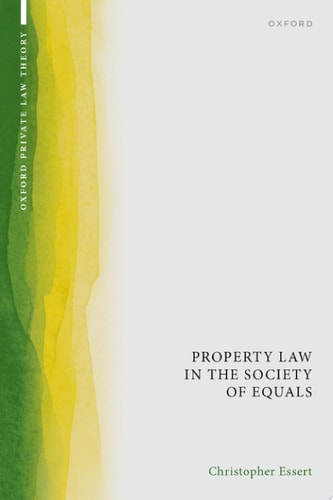
Property Law in the Society of Equals (Oxford Private Law Theory)
0
0
As an Amazon Associate and affiliate partner, Menrva Books earns from qualifying purchases. Learn more
Author Description
Property is often seen as fundamentally inegalitarian, leading many to believe that a world without property would be a more equal one. Property Law in the Society of Equals challenges this view, demonstrating instead that property is essential for a society of equals. Property, as the legal realization of the idea of yours and mine, creates the conditions for us to relate to each other on equal terms.This conception of property allows for an examination of many of its core doctrines, including trespass and nuisance law, the law of acquisition, possession, and transfer, the law of leases, and the law of servitudes. It also reveals the distinctive place of property within private law more generally, and how to think about novel or controversial cases of property rights. Moreover, the idea that property is fundamentally egalitarian generates a radical critique of our present systems of property. It shows that various forms of public law regulation of property - including the right to housing and public housing itself - are justified by the same principles that underlie the need for property in the first place.Property Law in the Society of Equals offers a thorough and insightful account of a fundamental legal subject matter, and a compelling call for the reform of property on more egalitarian lines.
Menrva's Summary
THE THESIS
Does the institution of property inherently conflict with the principles of an egalitarian society, or is it a necessary component for achieving equality? Christopher Essert, a scholar in legal theory, argues that property is not merely an inegalitarian construct but a foundational requirement for individuals to interact as equals. By framing property as the legal realization of 'yours and mine,' the author provides a normative framework that reconciles private ownership with the requirements of a society of equals.
THE SCOPE MAP
What You Will Find
- Analysis of core property doctrines including trespass, nuisance, acquisition, and transfer.
- Examination of the legal mechanics governing leases and servitudes.
- A theoretical framework connecting private property rights to public law regulations like housing.
- A normative critique of existing property systems and proposals for egalitarian reform.
THE AUTHORITY PERSPECTIVE
Legal scholars and theorists view this work as a significant contribution to private law theory, particularly for its attempt to bridge the gap between property rights and egalitarian political philosophy. Readers frequently note the academic density of the prose, which is intended for an audience familiar with legal doctrine and jurisprudential debate.
Page Count:
248
Publication Date:
2024-01-01
Publisher:
Oxford University Press
ISBN-10:
0197768954
ISBN-13:
9780197768952
Politics
Political Philosophy
Jurisprudence
Class
Property Law
Systems Theory
Property
Private Law
Legal Theory
Law
Community Tags
Similar Books