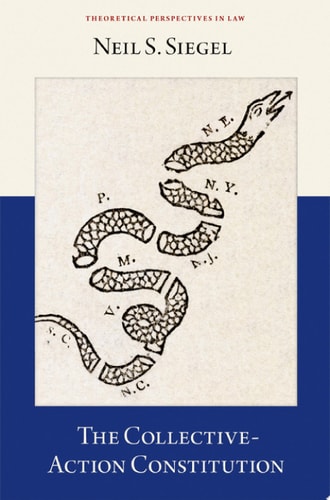
The Collective-Action Constitution (Theoretical Perspectives in Law)
0
0
As an Amazon Associate and affiliate partner, Menrva Books earns from qualifying purchases. Learn more
Author Description
The United States Constitution was established primarily because of the widely recognized failures of its predecessor, the Articles of Confederation, to adequately address "collective-action problems" facing the states. These problems included funding the national government, regulating foreign and interstate commerce, and defending the nation from attack. Meeting such challenges required the states to cooperate or coordinate their behavior, but they often struggled to do so both inside and outside the Confederation Congress. By empowering Congress to solve collective-action problems, and by creating a national executive and judiciary to enforce federal law, the Constitution promised a substantially more effective federal government.An important read for scholars, lawyers, judges, and students alike, Neil Siegel's The Collective-Action Constitution addresses how the U.S. Constitution is, in a fundamental sense, the Collective-Action Constitution. Any faithful account of what the Constitution is for and how it should be interpreted must include the primary structural purpose of empowering the federal government to solve collective-action problems for the states and preventing them from causing such problems. This book offers a thorough examination of the collective-action principles animating the structure of the Constitution and how they should be applied to meet many of the most daunting challenges facing American society today.
Menrva's Summary
THE THESIS
This book investigates whether the primary structural purpose of the United States Constitution is to empower the federal government to resolve collective-action problems among the states. Neil S. Siegel, a professor of law and political science, utilizes historical analysis and legal theory to argue that the Constitution was designed specifically to overcome the coordination failures inherent in the Articles of Confederation. He presents a framework for constitutional interpretation that centers on the federal government's role in managing interstate cooperation and preventing states from externalizing costs onto one another. By applying this lens to contemporary issues, the author demonstrates how structural constitutional principles remain relevant for addressing modern governance challenges.
THE SCOPE MAP
What You Will Find
- Historical analysis of the Articles of Confederation and the failures of state coordination.
- A theoretical framework for interpreting constitutional structure through the lens of collective-action problems.
- Examination of federal powers regarding interstate commerce, national defense, and government funding.
- Application of collective-action principles to current American legal and political challenges.
THE AUTHORITY PERSPECTIVE
Legal scholars and constitutional historians view this work as a significant contribution to the structuralist interpretation of American law. Readers frequently note the academic density of the prose, which serves as a rigorous resource for students and practitioners of constitutional theory.
Page Count:
520
Publication Date:
2024-01-01
Publisher:
Oxford University Press
ISBN-10:
0197760961
ISBN-13:
9780197760963
History
Constitutional Law
Law
Jurisprudence
Government
Federal Jurisdiction
Systems Theory
Community Tags
Similar Books