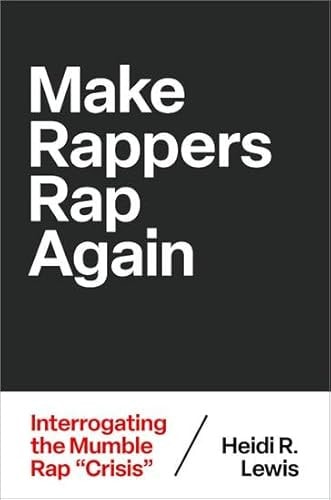
Make Rappers Rap Again: Interrogating the Mumble Rap "Crisis"
0
0
As an Amazon Associate and affiliate partner, Menrva Books earns from qualifying purchases. Learn more
Author Description
Many Critics Claim Mumble Rap Is Not Real Hip Hop (or The Most Authentic Or Pure Hip Hop), Because Mumble Rappers Are Ignorant About Hip Hop History, Disrespectful Toward Hip Hop Elders, Too Similar, Unskilled, Prone To Rapping About Nonsense, And Too Soft Or Feminine. Some Critics Have Even Declared Hip Hop Dead (again). Contrarily And Perhaps Controversially, Lewis Argues Mumble Rap Is Real Hip Hop. Relying Primarily On Discourse Analysis, Lewis Examines Mumble Rap's Congruence With Oft Forgotten Or Subjugated Hip Hop Cornerstones Like Illegibility, Melody, The Dj, And The Subgenre, As Well As The Ways Most Mumble Rappers Practice Citational And Collaborative Politics That Are Congruent With Real Hip Hop. She Also Takes A Critical Approach To Examining The Mumble Rap Sound, Arguing It Is Much More Complicated Than It's Often Characterized, Especially Concerning Flow And Production. To Explain The Subjugation Of Mumble Rap, Lewis Situates The Subgenre As Southern And Examines The Ways It Challenges Dominant Notions About Real Hip Hop Masculinity Vis-à-vis Attention To The Mental And Emotional, Drug Use And Addiction, And The Fallacies Of Gender And Sexuality Norms-- Provided By Publisher.
Menrva's Summary
THE THESIS
Heidi R. Lewis investigates the cultural legitimacy of mumble rap by challenging the prevailing critical consensus that dismisses the subgenre as an inferior or inauthentic iteration of hip hop. Drawing on her background in feminist and critical race theory, Lewis utilizes discourse analysis to argue that mumble rap aligns with foundational hip hop principles such as sonic experimentation, collaborative politics, and regional innovation. By situating the subgenre within its Southern roots, she demonstrates how it disrupts traditional expectations of masculinity and artistic expression in the broader hip hop landscape.
THE SCOPE MAP
What You Will Find
- Analysis of the Southern origins and cultural context of mumble rap.
- Examination of the role of melody, production, and flow in contemporary rap music.
- Critical discourse analysis of the debates surrounding hip hop authenticity and history.
- Exploration of how mumble rap challenges normative standards of gender, sexuality, and emotional expression.
THE AUTHORITY PERSPECTIVE
Experts in musicology and African American studies recognize this work as a significant intervention in the ongoing debate regarding hip hop's evolution and boundaries. Readers frequently note the academic rigor of the prose and the author's ability to bridge the gap between popular music criticism and formal cultural theory.
Page Count:
208
Publication Date:
2025-06-16
Publisher:
Oxford University Press
ISBN-10:
0197773818
ISBN-13:
9780197773819
Music
Hip-hop
Musical Genres
Sociology
Community Tags
Similar Books