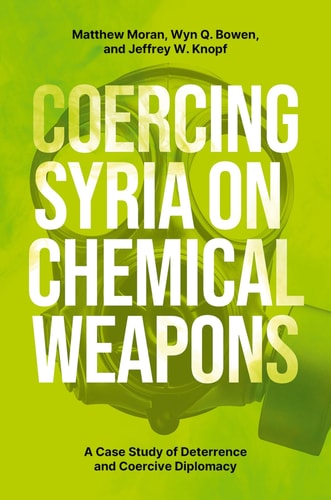
Coercing Syria on Chemical Weapons: A Case Study of Deterrence and Coercive Diplomacy
0
0
As an Amazon Associate and affiliate partner, Menrva Books earns from qualifying purchases. Learn more
Author Description
In 2012, US President Barack Obama stated that Syrian government usage of chemical weapons on its population would cross a red line that would require the US government to reconsider its approach to the civil war then underway in Syria. Syria subsequently used such weapons, creating a policy dilemma for the United States about how to respond to Syrian President Bashar al-Assad's violation of the red line.In Coercing Syria on Chemical Weapons, Matthew Moran, Wyn Q. Bowen, and Jeffrey W. Knopf examine efforts by the United States, sometimes acting with France and the United Kingdom, to respond to Syria's possession and use of chemical weapons over the course of its civil war. In particular, they focus on US strategy, covering the presidencies of both Barack Obama and Donald Trump, which relied heavily on coercion involving both deterrent and compellent variants of that strategy. As the authors show, policies directed at the ruling Assad regime in Syria attempted to deter chemical weapons attacks and to compel Syria into giving up its chemical arsenal with mixed outcomes. Drawing on existing literature on deterrence and coercive diplomacy to identify three propositions--involving credibility, motivations, and assurances--the book explains the mixed record of coercive success and failure and examines how effective coercive strategies were at different points and why.Deriving lessons from the most significant attempt in the post-Cold War era to deter use of a weapon of mass destruction, this book offers theoretical and practical lessons for both security studies scholars and policymakers.
Menrva's Summary
THE THESIS
This book investigates the efficacy of coercive diplomacy and deterrence strategies employed by the United States and its allies in response to the Syrian regime's use of chemical weapons during the civil war. The authors, Jeffrey W. Knopf, Matthew Moran, and Wyn Q. Bowen, utilize a framework grounded in security studies to analyze the complex policy dilemmas faced by the Obama and Trump administrations. By evaluating the credibility of threats, the motivations of the Assad regime, and the role of security assurances, the text provides a systematic assessment of why these international efforts achieved mixed results. The work serves as a critical examination of how state actors attempt to influence the behavior of adversaries through both deterrent and compellent strategies.
THE SCOPE MAP
What You Will Find
- Analysis of US, French, and British diplomatic and military strategies regarding the Syrian chemical weapons crisis.
- A theoretical framework evaluating the three pillars of coercion: credibility, motivations, and assurances.
- Comparative study of policy approaches across the Obama and Trump presidential administrations.
- Lessons derived from post-Cold War efforts to prevent the use of weapons of mass destruction.
THE AUTHORITY PERSPECTIVE
Experts view this work as a significant contribution to the study of coercive diplomacy, offering a rigorous application of theory to a contemporary security crisis. Scholars and policymakers frequently cite the text for its balanced assessment of the limitations and successes inherent in international intervention strategies.
Page Count:
280
Publication Date:
2025-05-14
Publisher:
Oxford University Press
ISBN-10:
019777038X
ISBN-13:
9780197770382
Politics
Military History
Security Studies
Specific Topics
Diplomacy
World politics
International relations
Community Tags
Similar Books