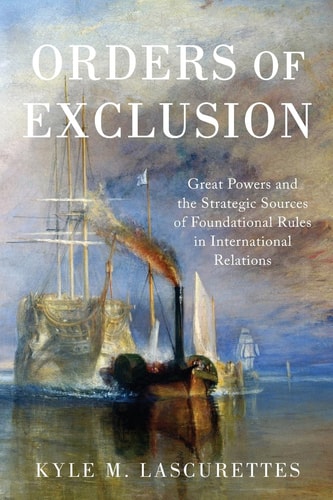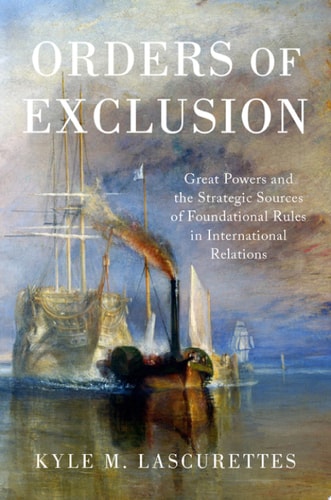
Orders of Exclusion: Great Powers and the Strategic Sources of Foundational Rules in International Relations
0
0
As an Amazon Associate and affiliate partner, Menrva Books earns from qualifying purchases. Learn more
Author Description
When and why do powerful countries seek to enact major changes to international order, the broad set of rules that guide behavior in world politics? This question is particularly important today given the Trump administration's clear disregard for the reigning liberal international order in the United States. Across the globe, there is also uncertainty over what China might seek to replace that order with as it continues to amass power and influence. Together, these developments mean that what motivates great powers to shape and change order will remain at the forefront of debates over the future of world politics. Prior studies have focused on how the origins of international orders have been consensus-driven and inclusive. By contrast, Kyle M. Lascurettes argues in Orders of Exclusion that the propelling motivation for great power order building has typically been exclusionary. Dominant powers pursue fundamental changes to order when they perceive a major new threat on the horizon. Moreover, they do so for the purpose of targeting this perceived threat, be it another powerful state or a foreboding ideological movement. The goal of foundational rule writing in international relations, then, is blocking that threatening entity from amassing further influence, a motive Lascurettes illustrates at work across more than three hundred years of history. Far from falling outside of the bounds of traditional statecraft, order building is the continuation of power politics by other means.
Menrva's Summary
THE THESIS
What motivates great powers to fundamentally reshape international order, and why do they choose to do so through exclusionary rule-making? Kyle M. Lascurettes, an expert in international relations, challenges the conventional view that international orders are primarily built through consensus and inclusivity. Drawing on over three hundred years of historical evidence, he argues that dominant states construct foundational rules as a strategic mechanism to isolate and block perceived threats, whether those threats manifest as rival states or ideological movements.
THE SCOPE MAP
What You Will Find
- A historical analysis of international order building spanning three centuries.
- A theoretical framework linking power politics to the creation of foundational international rules.
- Case studies demonstrating how great powers utilize exclusionary tactics to maintain dominance.
Scope Limits
- The text does not provide a predictive model for future specific geopolitical events.
- It does not focus on the internal domestic policy mechanics of the states involved, but rather their external strategic behavior.
THE AUTHORITY PERSPECTIVE
Scholars and practitioners of international relations identify this work as a significant contribution to the study of order-building and statecraft. Readers frequently note the clarity of the author's argument and the breadth of historical evidence provided to support his thesis.
Page Count:
342
Publication Date:
2020-04-03
Publisher:
Oxford University Press
ISBN-10:
019006854X
ISBN-13:
9780190068547
History
Politics
Geopolitics
International relations
World politics
Social History
Diplomacy
World
New Used & Rental Textbooks
Politics & Government
Community Tags
Similar Books