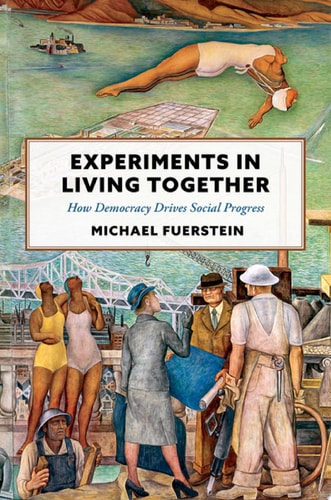
Experiments in Living Together: How Democracy Drives Social Progress
0
0
As an Amazon Associate and affiliate partner, Menrva Books earns from qualifying purchases. Learn more
Author Description
Over the past 70 years, the United States has undergone major moral shifts surrounding gender, sexual orientation, and race. While these changes have been incomplete and imperfect, they nonetheless represent stunning improvements in the human condition which have been supported by democracy. While on its face democratic governance embodies the promise of protest, free expression, and social change, the recent surge of populism has provoked some cynicism about democracy and the potential ignorance and irrationality of democratic citizens. This debate raises questions around the role of democracy in social progress, democracy's definitive principles and ideals, and the tension between democracy's characteristic aspirations and the disappointing realities of real-world politics.Michael Fuerstein addresses these questions, presenting a fresh philosophical account of social progress that focuses on democracy, delivering an innovative rebuttal to skeptics inspired by the recent populist wave. Following in the tradition of John Dewey, he argues that democracy enables progress through "experiments in living": innovations in social practice that transform social emotions and identities and cultivate moral learning.Drawing on research in social psychology and several detailed historical case studies--same-sex marriage, women's integration into the workforce, and school desegregation--Fuerstein illuminates the critical role of novel experience in building community: linkages of emotion and identity across a democratic public, which enable diverse citizens to flourish together. Challenging technocratic views which imply that democracy is undermined by citizens' ignorance and incompetence, Fuerstein suggests that the remedy for democracy's contemporary malaise must target failures of community more than failures of knowledge or skill, a change which will require a new round of experimental innovations in social life.
Menrva's Summary
THE THESIS
Does democracy function as an effective mechanism for moral and social progress despite the challenges posed by modern populism and citizen skepticism? Michael Fuerstein, a philosopher, examines the intersection of democratic governance and social evolution by building upon the pragmatist tradition of John Dewey. He argues that democracy facilitates progress not through technocratic expertise, but through "experiments in living" that reshape social identities and foster moral learning. By analyzing historical shifts in civil rights and social norms, the author provides a framework for understanding how democratic participation can overcome contemporary political malaise.
THE SCOPE MAP
What You Will Find
- Historical case studies including same-sex marriage, women's workforce integration, and school desegregation.
- A philosophical framework connecting democratic participation to social psychology and moral development.
- An analysis of the tension between democratic ideals and the realities of populist political movements.
- A critique of technocratic governance models that prioritize citizen knowledge over community-building.
THE AUTHORITY PERSPECTIVE
Scholars and political theorists view this work as a significant contribution to the ongoing debate regarding the viability of democratic institutions in a polarized era. Readers frequently note the accessible yet rigorous philosophical approach, which provides a constructive alternative to common cynical perspectives on democratic competence.
Page Count:
328
Publication Date:
2024-11-12
Publisher:
Oxford University Press
ISBN-10:
0197784283
ISBN-13:
9780197784280
Politics
Philosophy
Sociology
Social Philosophy
Ethics & Morality
Progress
Society
Progrès
Democracy
Community Tags
Similar Books