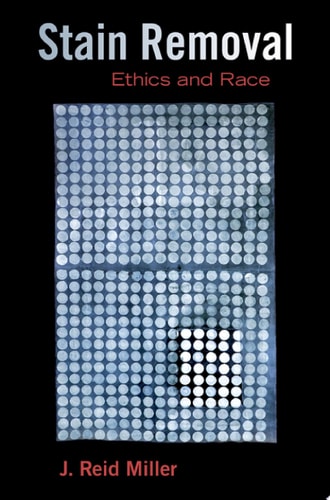
Stain Removal: Ethics and Race
0
0
As an Amazon Associate and affiliate partner, Menrva Books earns from qualifying purchases. Learn more
Author Description
Martin Luther King, Jr. famously expressed his dream that his children would "one day not be judged by the color of their skin, but by the content of their character." In his vision, a person's ethical qualities would be understood in spite of his or her body rather than through it. In general, we think that a person's actions should not be judged according to their physical features, such as race. In fact, we see evaluations based on a subject's race or other bodily traits as illegitimate. But Stain Removal argues that our perception of a person's actions always entails judgments of the body. It therefore challenges modern moral theory's premise that a subject's deeds and not its bodily traits count as primary objects of evaluation. Drawing on modern and pre-modern accounts of how ethical knowledge originates, from the Biblical story of Ham, to Socrates, Immanuel Kant, Alain Locke, Frantz Fanon, Langston Hughes, Onora O'Neill, and Louis Althusser, the book suggests that our recognition of both a person and that person's deeds demands an evaluative context. From this it proposes that all perception is "evaluative perception." Through the metaphor of the stain, J. Reid Miller traces the long history of thought suggesting that embodiments like race can and do signify ethical qualities. He argues that these qualities do not "attach" to subjects from the outside-like a stain on innocent and unraced beings-but are instead what allow us to see people as distinct ethical individuals. The objective of ethics, he shows, is not to determine whether race is good or bad but to illustrate how our "unique" personal traits emerge through our multiple relations to others. The consequence is that, contrary to King's vision, it is only through judgments of "skin" and other bodily features that the ethical "content" of subjects can be recognized.
Menrva's Summary
THE THESIS
Stain Removal investigates the core question of whether ethical judgment can exist independently of physical traits like race, ultimately arguing that all human perception is inherently evaluative. Author J. Reid Miller challenges the modern moral premise that a subject's deeds should be evaluated separately from their bodily traits. By synthesizing historical and philosophical perspectives, Miller posits that our recognition of individual ethical character is inextricably linked to our perception of physical embodiment.
THE SCOPE MAP
What You Will Find
- A philosophical framework defining all perception as evaluative perception.
- Historical analysis of the metaphor of the stain in ethical discourse.
- Interdisciplinary synthesis of thinkers including Socrates, Immanuel Kant, Alain Locke, Frantz Fanon, and Louis Althusser.
Scope Limits
- The text does not provide a practical guide for social policy or legal reform regarding racial discrimination.
- It does not offer a sociological study of contemporary racial attitudes but focuses strictly on the philosophical history of moral evaluation.
THE AUTHORITY PERSPECTIVE
Scholars and readers often note the high level of academic density in Miller's prose, which requires a strong background in moral philosophy to navigate effectively. Experts highlight this work as a provocative contribution to the intersection of ethics and critical race theory, specifically for its challenge to traditional liberal moral frameworks.
Page Count:
216
Publication Date:
2016-01-01
Publisher:
Oxford University Press
ISBN-10:
0190648309
ISBN-13:
9780190648305
Philosophy
Politics
Social Philosophy
American Government
Minority Studies
Race Studies
Political
New Used & Rental Textbooks
Ethics & Morality
Social Theory
Politics & Government
United States
Ethics
Ethnic Studies
Community Tags
Similar Books