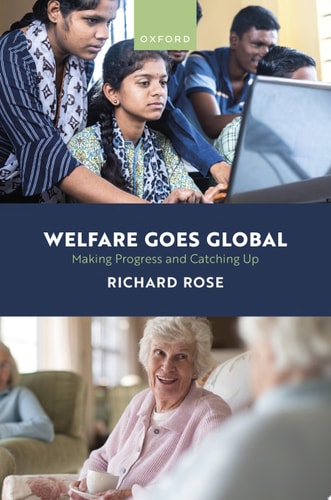
Welfare Goes Global: Making Progress and Catching Up
0
0
As an Amazon Associate and affiliate partner, Menrva Books earns from qualifying purchases. Learn more
Author Description
This innovative book shows that the health, education, and employment of billions of people have been improving on every continent in the past three decades. The globalization of welfare has had the biggest impact in developing countries, where more than five-sixths of the world's population lives. In Africa, Asia, Latin America, and the Middle East there has been great progress in eradicating infant mortality and illiteracy, people are living longer, and more young people are able to obtain a secondary education. These achievements are the product of a welfare mix combining resources of the household, the market, and the state. Given low starting points, only a minority of developing countries have already caught up with the high standards of welfare in Europe, the United States and Canada, and the Asia Pacific region. Slow but steady rates of progress show that people in a majority of developing countries can expect to catch up with the high, fixed standards of welfare in the next three decades. This will happen sooner in China and later in India, because China has been unusually successful in using its resources to promote welfare while India has been below the global average. These conclusions are based on Richard Rose's systematic analysis of the Global Welfare Database, which combines official and unofficial data covering 95 per cent of the world's population. The success of highly developed countries raises questions about how much is enough welfare. At what age will young people learn more by leaving classrooms and becoming employees? Is length of life or quality of life more important for older people? Should unpaid work caring for children and older family members have the same value as working and paying taxes in the official economy?
Menrva's Summary
THE THESIS
This book investigates the global trajectory of welfare improvements, questioning whether developing nations can realistically bridge the gap in health, education, and employment standards compared to highly developed regions. Richard Rose, a prominent political scientist, utilizes extensive data from the Global Welfare Database to analyze trends across continents over the past three decades. He argues that welfare progress is driven by a complex mix of household, market, and state resources, suggesting that while progress is uneven, a majority of developing nations are on a path toward catching up with Western standards within the next thirty years.
THE SCOPE MAP
What You Will Find
- Longitudinal analysis of health, education, and employment metrics across Africa, Asia, Latin America, and the Middle East.
- A comparative framework evaluating the welfare mix of state, market, and household contributions.
- Quantitative evidence derived from the Global Welfare Database covering 95 percent of the world's population.
- Critical inquiry into the qualitative aspects of welfare, such as the value of unpaid care work and the optimal duration of formal education.
THE AUTHORITY PERSPECTIVE
Experts recognize this work as a significant contribution to development studies due to its massive data synthesis and systematic approach to global welfare metrics. Readers frequently note the academic density of the prose, which provides a rigorous foundation for understanding long-term socioeconomic convergence.
Page Count:
256
Publication Date:
2024-01-01
Publisher:
Oxford University Press
ISBN-10:
0198908466
ISBN-13:
9780198908463
Politics
Economics
Economic Policy & Development
Public Policy
Globalization
Progress
Sociology
Sociology & anthropology
Social Science
Progrès
Society
Systems Theory
Community Tags
Other Editions(2)

Similar Books