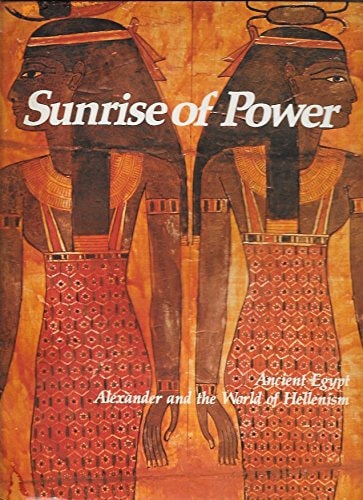
Sunrise of Power: Ancient Egypt, Alexander and the World of Hellenism
0
0
As an Amazon Associate and affiliate partner, Menrva Books earns from qualifying purchases. Learn more
Author Description
From its earliest beginnings thousands of years ago, the course of man’s progress has been measured by his empires. Large, dynamic flows of power, people, and culture that merge, thrive, then break apart - the pieces only to merge again in a new configuration, the process to be repeated. Through pictures and words, "Empires: Their Rise and Fall" brings the reader face to face with many of the world’s greatest empires. Full-color photographs are combined with an absorbing narrative in a lively historical account of each empire and an examination of the period’s most enduring cultural achievements. This volume in the series focuses on Ancient Egypt, and Alexander and the World of Hellenism. In light of the barbarism that has existed over the history of civilized man, it is remarkable how much of ancient societies remains. For the earliest civilizations, our knowledge begins with scanty, often mythological, lists of kings. In the temples of ancient Egypt, the prowess of the king is dramatized in battle, in receiving tributes of the vanquished, and in other ennobling pursuits that glorify his reign. The greater part of the scenes and texts represented in the temples, however, illustrates and describes the rituals performed by the king for the gods. Although the Egyptian kings are identified by name, their personalities rarely rise above their activities. Yet beneath the impression of cold anonymity, glimpses of individuals do, on occasion, emerge. In contrast, the literature and documents of Hellenistic society reveal a more complex society. The polyglot atmosphere of the cosmopolis not only gave rise to many tensions, but also fostered an environment that must have been both lively and stimulating. So it was that the new Macedonian dynasties in Greece, Syria, and Mesopotamia by slow degrees transformed the Western world, creating the new order of Hellenism. The legacies of Greece, Palestine and the Levant, Mesopotamia, and Egypt were incorporated into this new order.
Menrva's Summary
THE THESIS
This volume investigates the cyclical nature of imperial power and the cultural legacies left by Ancient Egypt and the Hellenistic world. Joyce Milton provides a historical overview of these civilizations, utilizing a combination of archaeological context and textual analysis to examine how these societies functioned, expanded, and eventually integrated into broader historical configurations. The text focuses on the transition from the ritual-heavy governance of Egyptian pharaohs to the complex, polyglot social structures of the Macedonian-led Hellenistic era.
THE SCOPE MAP
What You Will Find
- Historical analysis of Ancient Egyptian temple rituals and kingship
- Examination of the social and political dynamics of the Hellenistic cosmopolis
- Overview of the cultural synthesis between Greece, Egypt, and Mesopotamia
- Visual documentation through full-color photography
Scope Limits
- Does not provide an exhaustive academic study of specific archaeological sites
- Does not cover the entirety of the Hellenistic period beyond the initial rise of the Macedonian dynasties
THE AUTHORITY PERSPECTIVE
Readers frequently note that this text serves as an accessible entry point for those interested in the broad strokes of ancient imperial history. Experts highlight the balance between visual elements and narrative prose as a useful tool for general education on the subject.
Page Count:
167
Publication Date:
1980-01-01
Publisher:
Edgell Communications
ISBN-10:
0150040245
ISBN-13:
9780150040248
History
Egyptology
Egypt
World history
Middle East
World
Community Tags
Similar Books