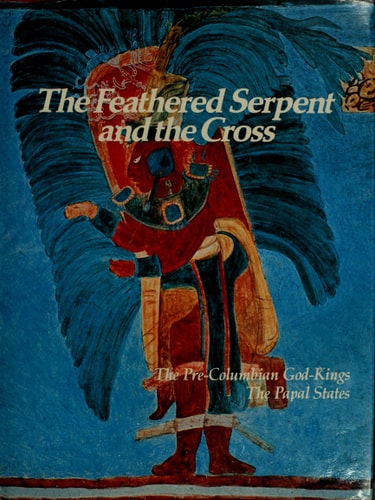
The Serpent and the Robe: The Pre-Columbian God-Kings; The Papal States
0
0
As an Amazon Associate and affiliate partner, Menrva Books earns from qualifying purchases. Learn more
Author Description
From its earliest beginnings thousands of years ago, the course of man’s progress has been measured by his empires. Large, dynamic flows of power, people, and culture that merge, thrive, then break apart - the pieces only to merge again in a new configuration, the process to be repeated. Through pictures and words, "Empires: Their Rise and Fall" brings the reader face to face with many of the world’s greatest empires. Full-color photographs are combined with an absorbing narrative in a lively historical account of each empire and an examination of the period’s most enduring cultural achievements. This volume in the series focuses on The Pre-Columbian God-Kings, and The Papal States. From the simple agricultural life over 4000 years before Christ to the arrival of the Spaniards in South America, the vibrant, dynamic societies of the Aztecs, the Mayas, and the Incas are still shrouded in uncertainty among scholars as to the paths of their social, cultural, and political development. Yet Pre-Columbian refinements in crafts and the arts continue to be studied and enjoyed by people the world over, their true histories still temptingly beyond our grasp. As to the Papal States, there is no lack of dramatic incident in the history of the papacy, particularly in the early days of the Church. The Christian leaders of the infant Church were, in a sense, minority heroes who reconciled themselves to the possibility of meeting death by crucifixion or enduring a lifetime of servitude, torture, or exile. Persecuted by the state, members of the early Christian communities were often forced to live in catacombs, underground tunnels that also served as cemeteries. From these uncertain beginnings grew an institution that was, at selected moments in history, to wield supreme spiritual and temporal authority throughout the world.
Menrva's Summary
THE THESIS
This volume investigates the historical trajectories of two distinct power structures: the Pre-Columbian civilizations of the Americas and the development of the Papal States. The authors, Joyce Milton, Norman Harrison, and Robert Orsi, utilize a combination of historical narrative and visual documentation to examine how these disparate entities established authority, managed cultural growth, and navigated periods of significant political transition. The work frames these empires as dynamic systems that reflect broader patterns of human societal evolution.
THE SCOPE MAP
What You Will Find
- Historical overview of Aztec, Maya, and Inca social and political development
- Analysis of the early Christian Church and the emergence of the Papal States
- Examination of cultural and artistic achievements in Pre-Columbian societies
- Discussion of the transition from persecuted minority to temporal authority within the Church
Scope Limits
- Does not provide exhaustive archaeological data for every Pre-Columbian site
- Does not offer a comprehensive theological history of the entire papacy
THE AUTHORITY PERSPECTIVE
Readers frequently note that the text serves as an accessible entry point for those interested in comparative historical studies. Experts highlight the volume's utility as a visual-heavy survey that balances broad historical themes with specific cultural case studies.
Page Count:
168
Publication Date:
1986-12-01
Publisher:
Boston Publishing
ISBN-10:
015004030X
ISBN-13:
9780150040309
History
Italy
Papal History
Religious History
United States
World history
Americas
Europe
Pre-Columbian History
Native American
Mayan
Community Tags
Similar Books