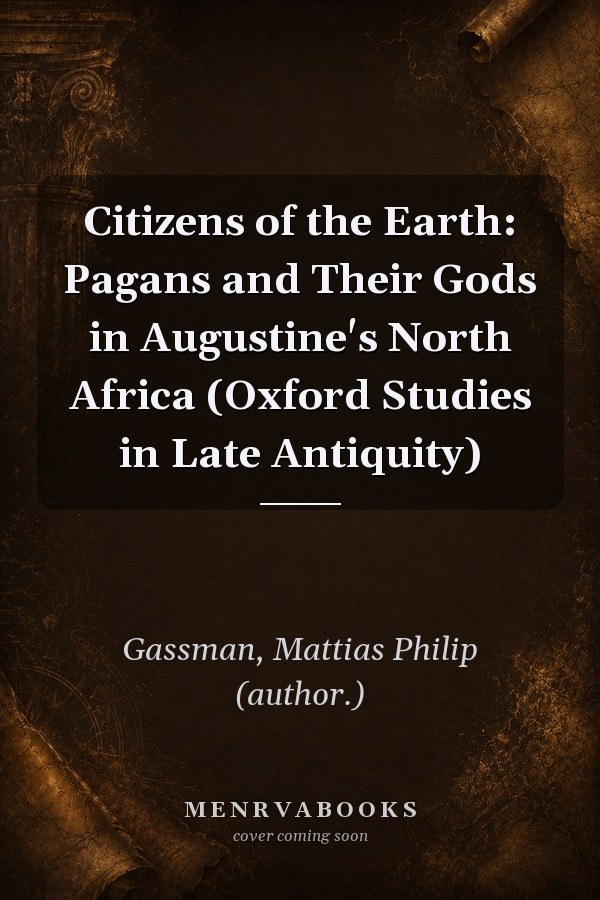
Citizens of the Earth: Pagans and Their Gods in Augustine's North Africa
0
0
As an Amazon Associate and affiliate partner, Menrva Books earns from qualifying purchases. Learn more
Author Description
Citizens Of The Earth Presents The First Comprehensive Account Of Augustine's Engagement With Traditional Roman Religion. A Multifaceted Case-study In The Christianization Of The Roman Empire, It Anchors Augustine's Works In Their Intellectual And Social Context, Narrating Political And Intellectual Renegotiation Of The Public Cults Of North Africa From The 390s Until After Augustine's Death In 430. At The Same Time, It Tests Modern Conceptions Of The Role Of Religious Conviction And Religious Difference In Late Antique Society Against The Ideas Of One Of The Most Influential Late Roman Thinkers. Approaching Augustine Simultaneously As Thinker, Practical Preacher, And Observer Of His North African World, Citizens Of The Earth Synthesizes Augustine's Ideas About Religion From Sermons And Treatises, Describes How His Polemical Approach To The Roman Gods Developed Across His Career, And Reconstructs Competing Ideas Developed By His Interlocutors. It Emphasizes Pagan Conviction And Lay Religiosity, Argues That We Should See Augustine's Polemics As Attempts At Practical Outreach And Persuasion, And Stresses The Importance Of Conversion For Understanding The Pagan-christian Boundary. The Book Closes With Both Historical And Theoretical Conclusions. After Proposing That The Vandalic Conquest Of Carthage (439) Marked A Final Ending Point For Traditional, Public Religiosity In North Africa, It Considers How Augustine's Contributions Can Still Inform Modern Approaches To Late Antique Religion.
Menrva's Summary
THE THESIS
This work investigates how Augustine of Hippo navigated and challenged the persistence of traditional Roman religion within the social and political landscape of North Africa. Mattias Philip Gassman utilizes a rigorous analysis of Augustine's sermons, treatises, and historical context to argue that the bishop's polemics were not merely abstract theological debates but calculated efforts at practical persuasion and outreach. By situating Augustine as both a thinker and a social observer, the author reconstructs the competing religious convictions of the era to challenge modern assumptions about the nature of religious difference in the late Roman world.
THE SCOPE MAP
What You Will Find
- A detailed historical analysis of North African religious life from the 390s through the Vandalic conquest of 439.
- A methodological framework for interpreting Augustine's polemical writings as tools of social engagement.
- Examination of primary source material including sermons, letters, and theological treatises.
- A critical assessment of the pagan-Christian boundary and the role of conversion in late antique society.
THE AUTHORITY PERSPECTIVE
Scholars recognize this text as a significant contribution to the study of Augustine's social and political thought. Readers frequently note the academic density of the prose, which provides a nuanced understanding of the religious transitions occurring in the late Roman Empire.
Page Count:
336
Publication Date:
2026-02-02
Publisher:
Oxford University Press
ISBN-10:
0197805639
ISBN-13:
9780197805633
Religion
History
Philosophy
Witchcraft & Wicca
Christianity
New Age
Roman Empire
Late Antiquity
Community Tags
Similar Books