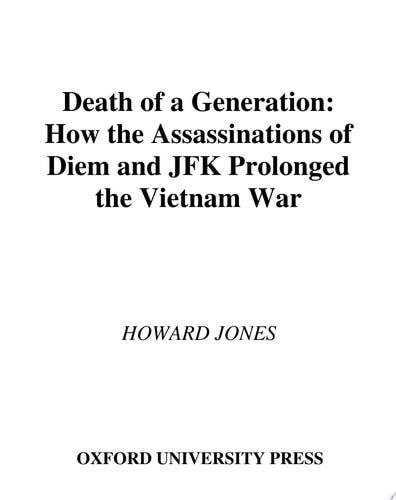
Death of a Generation
0
0
As an Amazon Associate and affiliate partner, Menrva Books earns from qualifying purchases. Learn more
Author Description
When John F. Kennedy Was Shot, Millions Were Left To Wonder How America, And The World, Would Have Been Different Had He Lived To Fulfill The Enormous Promise Of His Presidency. For Many Historians And Political Observers, What Kennedy Would And Would Not Have Done In Vietnam Has Been A Source Of Enduring Controversy. Now, Based On Convincing New Evidence--including A Startling Revelation About The Kennedy Administration's Involvement In The Assassination Of Premier Diem--howard Jones Argues That Kennedy Intended To Withdraw The Great Bulk Of American Soldiers And Pursue A Diplomatic Solution To The Crisis In Vietnam. Drawing Upon Recently Declassified Hearings By The Church Committee On The U.s. Role In Assassinations, Newly Released Tapes Of Kennedy White House Discussions, And Interviews With John Kenneth Galbraith, Robert Mcnamara, Dean Rusk, And Others From The President's Inner Circle, Jones Shows That Kennedy Firmly Believed That The Outcome Of The War Depended On The South Vietnamese. In The Spring Of 1962, He Instructed Secretary Of Defense Mcnamara To Draft A Withdrawal Plan Aimed At Having All Special Military Forces Home By The End Of 1965. The Comprehensive Plan For South Vietnam Was Ready For Approval In Early May 1963, But Then The Buddhist Revolt Erupted And Postponed The Program. Convinced That The War Was Not Winnable Under Diem's Leadership, President Kennedy Made His Most Critical Mistake--promoting A Coup As A Means For Facilitating A U.s. Withdrawal. In The Cruelest Of Ironies, The Coup Resulted In Diem's Death Followed By A State Of Turmoil In Vietnam That Further Obstructed Disengagement. Still, These Events Only Confirmed Kennedy's View About South Vietnam's Inability To Win The War And Therefore Did Not Lessen His Resolve To Reduce The U.s. Commitment. By The End Of November, However, The President Was Dead And Lyndon Johnson Began His Campaign Of Escalation. Jones Argues Forcefully That If Kennedy Had Not Been Assassinated, His Withdrawal
Menrva's Summary
THE THESIS
This book investigates the central historical question of whether President John F. Kennedy intended to withdraw American military forces from Vietnam had he not been assassinated. Howard Jones, a professor of history, utilizes a rigorous analytical framework to examine the internal decision-making processes of the Kennedy administration. By synthesizing newly declassified documents, White House tapes, and primary source interviews, Jones argues that Kennedy viewed the conflict as a South Vietnamese responsibility and actively sought a diplomatic exit strategy. The text posits that the administration's involvement in the coup against Premier Diem was a strategic error that paradoxically complicated, rather than facilitated, the planned American withdrawal.
THE SCOPE MAP
What You Will Find
- Analysis of the 1963 withdrawal plan for U.S. Special Forces.
- Examination of the Kennedy administration's role in the coup against Ngo Dinh Diem.
- Evidence derived from Church Committee hearings and internal White House recordings.
- Primary source insights from key figures including Robert McNamara and John Kenneth Galbraith.
THE AUTHORITY PERSPECTIVE
Historians and political analysts frequently cite this work as a significant contribution to the debate surrounding American foreign policy in Southeast Asia. The text is noted for its meticulous use of archival evidence to challenge long-standing assumptions regarding Kennedy's commitment to the Vietnam War.
Page Count:
592
Publication Date:
2003-01-01
Publisher:
Oxford University Press
ISBN-10:
0198021976
ISBN-13:
9780198021971
Biography
History
Military History
Vietnam War
Community Tags
Similar Books