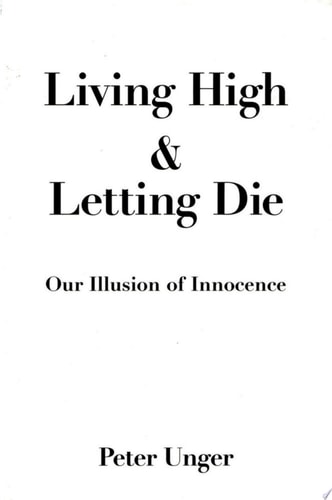
Living High and Letting Die
0
0
As an Amazon Associate and affiliate partner, Menrva Books earns from qualifying purchases. Learn more
Author Description
By Contributing A Few Hundred Dollars To A Charity Like Unicef, A Prosperous Person Can Ensure That Fewer Poor Children Die, And That More Will Live Reasonably Long, Worthwhile Lives. Even When Knowing This, However, Most People Send Nothing, And Almost All Of The Rest Send Little. What Is The Moral Status Of This Behavior? To Such Common Cases Of Letting Die, Our Untutored Response Is That, While It Is Not Very Good, Neither Is The Conduct Wrong. What Is The Source Of This Lenient Assessment? In This Contentious New Book, One Of Our Leading Philosophers Argues That Our Intuitions About Ethical Cases Are Generated Not By Basic Moral Values, But By Certain Distracting Psychological Dispositions That All Too Often Prevent Us From Reacting In Accord With Our Commitments. Through A Detailed Look At How These Tendencies Operate, Unger Shows That, On The Good Morality That We Already Accept, The Fatally Unhelpful Behavior Is Monstrously Wrong. By Uncovering The Eminently Sensible Ethics That We've Already Embraced Fully, And By Confronting Us With Empirical Facts And With Easily Followed Instructions For Lessening Serious Suffering Appropriately And Effectively, Unger's Book Points The Way To A Compassionate New Moral Philosophy.
Menrva's Summary
THE THESIS
Does the common failure to donate to life-saving charities constitute a moral failing, or is it ethically permissible? Peter Unger, a prominent philosopher, examines the discrepancy between our stated moral commitments and our actual behavior regarding global poverty. He argues that our lenient assessment of inaction is not rooted in sound ethical principles, but rather in psychological dispositions that distort our moral judgment. By analyzing these cognitive biases, Unger contends that failing to assist those in need is fundamentally wrong according to the moral standards we already claim to uphold.
THE SCOPE MAP
What You Will Find
- An analysis of the psychological mechanisms that influence moral intuition and decision-making.
- A critical evaluation of the distinction between active killing and passive letting die.
- Empirical evidence regarding the efficacy of charitable giving and its impact on global suffering.
- A proposed framework for aligning personal conduct with established ethical values.
THE AUTHORITY PERSPECTIVE
Philosophers and ethicists frequently cite this work as a provocative challenge to traditional moral intuitions regarding altruism and global responsibility. Readers often note the rigorous, argumentative nature of the text, which demands a high level of engagement with the author's logical premises.
Page Count:
200
Publication Date:
1996-01-01
Publisher:
Oxford University Press
ISBN-10:
0198026811
ISBN-13:
9780198026815
Philosophy
Ethics
Philanthropy
Social Science
Morality
Community Tags
Similar Books