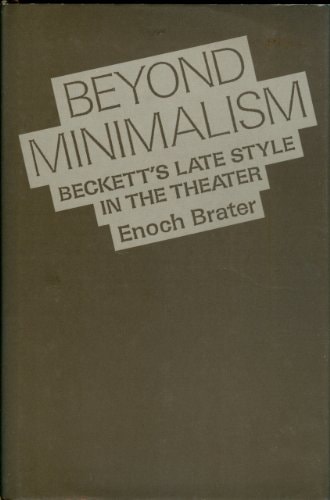
Beyond Minimalism: Beckett's Late Style in the Theatre
0
0
As an Amazon Associate and affiliate partner, Menrva Books earns from qualifying purchases. Learn more
Author Description
Beyond Minimalism explores Beckett's drama of the '70s and '80s, examining the ways in which play text and performance merge through the playwright's poetic idiom. Beginning with Not I and continuing through Catastrophe and What Where, Brater examines the plays not only as texts but also as theater pieces. Discussing the technical and aesthetic demands that productions like Footfalls and Rockaby make on actor, director, and spectator, Brater clarifies the essential relationship between Beckett's achievement in the context of the breakdown of genre, performance poetry, and the electronic intrusion of the recorded voice as a new theatrical convention. In the course of his analysis Brater demonstrates how Beckett's late style in the theater both continues and clarifies the dramatic lyricism that is the hallmark of earlier works such as Endgame and Waiting for Godot.
Menrva's Summary
THE THESIS
This book investigates how Samuel Beckett’s late-career dramatic works redefine the boundaries between written text and live performance. Enoch Brater, a scholar of modern drama, analyzes the specific aesthetic and technical shifts present in Beckett’s plays from the 1970s and 1980s. By examining the playwright's transition toward a more distilled, poetic idiom, the author argues that these late works represent a significant evolution in theatrical convention and dramatic lyricism.
THE SCOPE MAP
What You Will Find
- Analysis of specific late-period plays including Not I, Catastrophe, and What Where.
- Examination of the integration of recorded voice and electronic media in live theater.
- Discussion of the collaborative demands placed on actors, directors, and spectators.
- Comparative study linking late-style techniques to earlier canonical works like Waiting for Godot.
THE AUTHORITY PERSPECTIVE
Scholars and theater practitioners frequently cite this work as a primary resource for understanding the technical nuances of Beckett’s later dramatic output. The text is recognized for its ability to bridge the gap between abstract literary theory and the practical realities of stage production.
Page Count:
0
Publication Date:
1990-01-01
Publisher:
Oxford University Press
ISBN-10:
0198021208
ISBN-13:
9780198021209
Drama
Literary Criticism
Modernism
Theater Studies
Community Tags
Similar Books