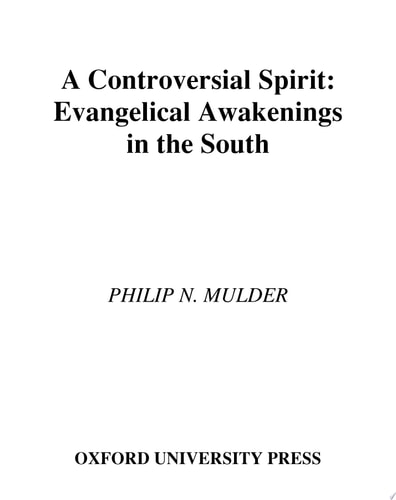
A Controversial Spirit: Evangelical Awakenings in the South
0
0
As an Amazon Associate and affiliate partner, Menrva Books earns from qualifying purchases. Learn more
Author Description
A Controversial Spirit offers a new perspective on the origins and nature of southern evangelicalism. Most recent historians have focused on the differences between evangelicals and non-evangelicals. This has led to the perception that during the "Era of Awakenings" (mid-18th and early 19th century) American evangelicals constituted a united front. Philip N. Mulder dispels this illusion, by examining the internal dynamics of evangelicalism. He focuses on the relationships among the Presbyterians, Baptists, and Methodists who introduced the new religious mood to the South between 1740 and 1820. Although the denominations shared the goal of saving souls, he finds, they disagreed over the correct definition of true religion and conversion. The Presbyterians and Baptists subordinated the freedom, innovation and experience of the awakenings to their particular denominational concerns. The Methodists, on the other hand, were more aggressive and innovative advocates of the New Light awakenings. They broke through the insularity of the other two groups and revolutionized the religious culture of the emerging nation. The American Revolution exacerbated the growing competition and jealousy among the denominations by displacing their common enemy, the established Anglican church. Former dissenters now turned to face each other. Free religious competition was transformative, Mulder argues. The necessity of competing for converts forced the Presbyterians and Baptists out of their narrow confines. More importantly, however, competition compromised the Methodists and their New Light ideals. Methodists had presented themselves as an ecumenical alternative to the rigid and rancorous denominations of England and America. Now they turned away from their open message of salvation, and began using their distinctive characteristics to separate themselves from other denominations. The Methodists thus succumbed to the evangelical pattern set by others - a pattern of distinction, insularity.
Menrva's Summary
THE THESIS
This work investigates the internal conflicts and competitive dynamics that shaped the development of southern evangelicalism between 1740 and 1820. Philip N. Mulder, a historian of American religion, challenges the prevailing view that early American evangelicals operated as a monolithic, united front. By analyzing the interactions between Presbyterians, Baptists, and Methodists, he argues that the necessity of competing for converts fundamentally altered the theological and organizational trajectory of these denominations. The study demonstrates how the decline of the established Anglican church post-Revolution forced these groups into a competitive landscape that prioritized denominational distinction over ecumenical unity.
THE SCOPE MAP
What You Will Find
- An examination of the "Era of Awakenings" in the American South from 1740 to 1820.
- Comparative analysis of Presbyterian, Baptist, and Methodist theological approaches to conversion.
- Historical evidence regarding the impact of the American Revolution on religious competition.
- A study of how institutional pressures transformed the initial "New Light" ideals of the Methodist movement.
THE AUTHORITY PERSPECTIVE
Scholars recognize this text as a significant contribution to the study of early American religious history, particularly for its nuanced look at denominational rivalry. Readers frequently note the academic density of the prose and the author's meticulous use of historical records to dismantle the myth of a unified evangelical movement.
Page Count:
248
Publication Date:
2002-01-01
Publisher:
Oxford University Press
ISBN-10:
0198030177
ISBN-13:
9780198030171
Religion
History
Linguistics
Kindle Store
Christian Denominations & Sects
Evangelism
Words Language & Grammar
Christianity
American History
Reference
Church Leadership
Evangelicalism
Kindle eBooks
Categories
Church History
Community Tags
Similar Books