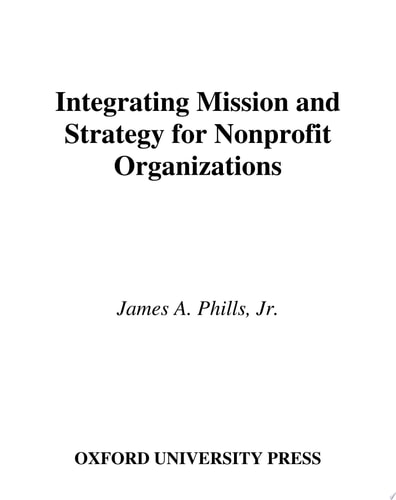
Integrating Mission and Strategy for Nonprofit Organizations
0
0
As an Amazon Associate and affiliate partner, Menrva Books earns from qualifying purchases. Learn more
Author Description
Today's Nonprofit Organizations Face An Environment Characterized By Higher Levels Of Competition For Funding, Clients And Audiences, Talent, And Recognition. In Addition, They Confront Greater Pressures From Donors, Government, And The Public To Demonstrate Efficiency, Effectiveness, Sustainability, And Accountability, While Intense Social Needs And Problems, As Well As The Desire For Growth, Drive Them To Expand Their Programs And Activities. Collectively, These Challenges Go To The Heart Of Fundamental Issues Of Mission And Strategy. Integrating Mission And Strategy For Nonprofit Organizations Applies And Adapts The Core Body Of General Management Knowledge About Mission, Strategy, And Execution To Help Nonprofit Leaders Deal With The Special Challenges They Face. It Strives To Draw On This Knowledge In A Way That Does Not Dilute Or Oversimplify, And At The Same Time Recognizes The Unique Features Of The Nonprofit Or Voluntary Sector. James A. Phills Develops An Action-oriented Framework That Combines Rigorous Analysis With The Practical Challenge Of Execution And Change. In Addition To Helping Nonprofit Leaders Think Through Important Decisions And Make Concrete Choices, The Book Also Provides A Shared Language And A Discipline That Can Serve As The Basis For More Productive Discussions Between The Individuals Who Lead Nonprofits, The Business Executives Who Serve On Their Boards, And The Philanthropists Who Support Their Organizations And Programs. This Last Objective Is Critical, Because Too Often Nonprofit Leaders And Board Members Complain That They Can't Reap The Benefits Of The Expertise Of Their Supporters, Funders, And Volunteers From The Business Sector. Phills Suggests That This Is Often The Result Of An Inability To Speak The Same Language And Draw On A Common Understanding Of Key Concepts, Such As Competition, Strategy, And Vision.
Menrva's Summary
THE THESIS
This book investigates how nonprofit organizations can effectively align their core mission with strategic execution to navigate an increasingly competitive and demanding environment. James A. Phills Jr., a scholar in social enterprise and management, synthesizes general management principles with the specific operational realities of the voluntary sector. He argues that by adopting a shared strategic language, nonprofit leaders can better bridge the communication gap between board members, business-sector supporters, and organizational staff to drive sustainable impact.
THE SCOPE MAP
What You Will Find
- A framework for integrating mission-driven goals with rigorous strategic planning.
- Methodologies for improving organizational efficiency and accountability in a competitive funding landscape.
- Analysis of the communication barriers between nonprofit leadership and business-sector board members.
- Practical tools for decision-making and executing organizational change.
THE AUTHORITY PERSPECTIVE
Experts and practitioners frequently cite this work as a foundational text for bridging the gap between corporate management theory and nonprofit practice. Readers often note the academic rigor of the framework, which provides a necessary structure for leaders navigating complex organizational growth and sustainability challenges.
Page Count:
272
Publication Date:
2007-01-01
Publisher:
Oxford University Press
ISBN-10:
0198038259
ISBN-13:
9780198038252
Business strategy
Management
Leadership
Nonfiction
Non-Profit Marketing
Nonprofit organizations
Community Tags
Other Editions(2)
Similar Books







Reader Comments
Share Your Thoughts
No comments yet. Be the first to share your thoughts!