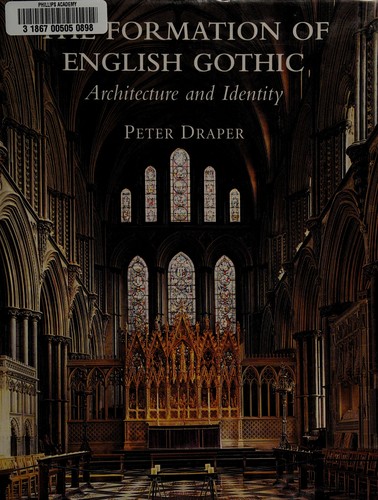
The Formation of English Gothic
0
0
As an Amazon Associate and affiliate partner, Menrva Books earns from qualifying purchases. Learn more
Author Description
In this original account of architecture in England between c.1150 and c.1250, Peter Draper explores how the assimilation of new ideas from France led to an English version of Gothic architecture that was quite distinct from Gothic expression elsewhere. The author considers the great cathedrals of England (Canterbury, Wells, Salisbury, Lincoln, Ely, York, Durham, and others) as well as parish churches and secular buildings, to examine the complex interrelations between architecture and its social and political functions. Architecture was an expression of identity, Draper finds, and the unique Gothic that developed in England was one of a number of manifestations of an emerging sense of national identity. The book inquires into such topics as the role of patrons, the relationships between patrons and architects, and the wide variety of factors that contributed to the process of creating a building. With 250 illustrations, including more than 50 in color, this book offers new ways of seeing and thinking about some of England's greatest and best-loved architecture. -- Book Jacket.
Menrva's Summary
THE THESIS
This book investigates the development of English Gothic architecture between 1150 and 1250. Peter Draper, a noted architectural historian, examines how the adoption of French Gothic ideas resulted in a uniquely English style. The book analyzes major cathedrals and secular buildings, exploring their social and political functions as expressions of emerging national identity. Draper considers the roles of patrons and architects, and the diverse factors influencing building creation.
THE SCOPE MAP
- Analysis of English Gothic architecture from c.1150 to c.1250.
- Exploration of the assimilation of French architectural ideas.
- Case studies of major English cathedrals (Canterbury, Wells, Salisbury, Lincoln, Ely, York, Durham, etc.).
- Examination of parish churches and secular buildings.
- Discussion of the interrelations between architecture, social, and political functions.
- Inquiry into the role of patrons and the patron-architect relationship.
- Consideration of factors contributing to building creation.
THE AUTHORITY PERSPECTIVE
The book is regarded as an original account that delves into the formation of English Gothic architecture during a pivotal period. It is noted for its comprehensive analysis of major English cathedrals and other structures, linking architectural development to social and political contexts. The work is praised for its detailed examination of patronage and the creative process behind building construction. With extensive illustrations, it offers new perspectives on England's significant architectural heritage.
Page Count:
287
Publication Date:
2006-01-01
ISBN-10:
0300120362
ISBN-13:
9780300120363
Non-Fiction
Architecture
History
Art History
Community Tags
Similar Books