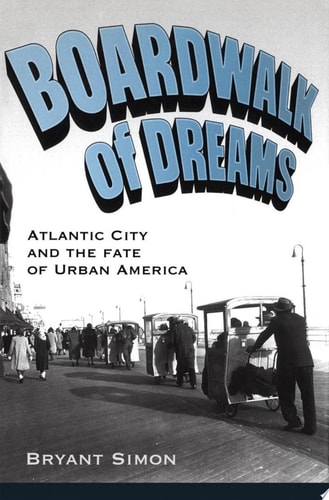
Boardwalk of Dreams
0
0
As an Amazon Associate and affiliate partner, Menrva Books earns from qualifying purchases. Learn more
Author Description
During The First Half Of The Twentieth Century, Atlantic City Was The Nation's Most Popular Middle-class Resort--the Home Of The Famed Boardwalk, The Miss America Pageant, And The Board Game Monopoly. By The Late 1960s, It Had Become A Symbol Of Urban Decay And Blight, Compared By Journalists To Bombed-out Dresden And War-torn Beirut. Several Decades And A Dozen Casinos Later, Atlantic City Is Again One Of America's Most Popular Tourist Spots, With Thirty-five Million Visitors A Year. Yet Most Stay For A Mere Six Hours, And The Highway Has Replaced The Boardwalk As The City's Most Important Thoroughfare. Today The City Doesn't Have A Single Movie Theater And Its One Supermarket Is A Virtual Fortress Protected By Metal Detectors And Security Guards. In This Wide-ranging Book, Bryant Simon Does Far More Than Tell A Nostalgic Tale Of Atlantic City's Rise, Near Death, And Reincarnation. He Turns The Depiction Of Middle-class Vacationers Into A Revealing Discussion Of The Boundaries Of Public Space In Urban America. In The Past, He Argues, The Public Was Never Really About Democracy, But About Exclusion. During Atlantic City's Heyday, African Americans Were Kept Off The Boardwalk And Away From The Beaches. The Overly Boisterous Or Improperly Dressed Were Kept Out Of Theaters And Hotel Lobbies By Uniformed Ushers And Police. The Creation Of Atlantic City As The Nation's Playground Was Dependent On Keeping Undesirables Out Of View Unless They Were Pushing Tourists Down The Boardwalk On Rickshaw-like Rolling Chairs Or Shimmying In Smoky Nightclubs. Desegregation Overturned This Racial Balance In The Mid-1960s, Making The City's Public Spaces More Open And Democratic, Too Open And Democratic For Many Middle-class Americans, Who Fled To Suburbs And Suburban-style Resorts Like Disneyworld. With The Opening Of The First Casino In 1978, The Urban Balance Once Again Shifted, Creating Twelve Separate, Heavily Guarded, Glittering Casinos Worlds Walled Off From The Dilapidated House
Menrva's Summary
THE THESIS
This book investigates the transformation of Atlantic City from a premier middle-class resort to a site of urban decay and eventual casino-driven redevelopment, questioning the true nature of public space in America. Bryant Simon, a professor of history, utilizes extensive archival research, journalistic accounts, and urban planning records to argue that the concept of the 'public' in American resorts was historically predicated on exclusion rather than democratic access. He posits that the city's decline and subsequent reinvention reflect broader national anxieties regarding race, class, and the privatization of shared environments.
THE SCOPE MAP
What You Will Find
- A historical analysis of Atlantic City from the early twentieth century through the casino era.
- An examination of racial segregation and social control mechanisms in public spaces.
- Case studies on the impact of desegregation on middle-class tourism patterns.
- A critique of how modern casino architecture creates walled-off, private environments within a struggling urban center.
THE AUTHORITY PERSPECTIVE
Scholars and urban historians frequently cite this work for its rigorous analysis of how social boundaries are physically constructed in American cities. Readers often note the academic density of the prose, which provides a comprehensive look at the intersection of tourism, race, and urban policy.
Page Count:
304
Publication Date:
2004-01-01
Publisher:
Oxford University Press
ISBN-10:
0198037449
ISBN-13:
9780198037446
History
American History
Urban Studies
Sociology
Community Tags
Similar Books