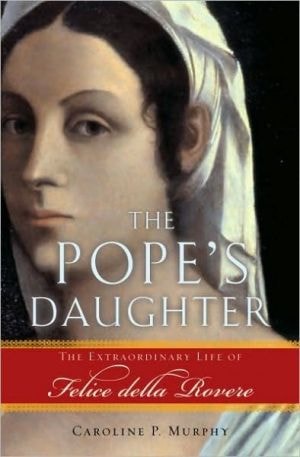
The Pope's Daughter: The Extraordinary Life of Felice della Rovere
0
0
As an Amazon Associate and affiliate partner, Menrva Books earns from qualifying purchases. Learn more
Author Description
The illegitimate daughter of Pope Julius II, Felice della Rovere became one of the most powerful and accomplished women of the Italian Renaissance. Now, Caroline Murphy vividly captures the untold story of a rare woman who moved with confidence through a world of popes and princes. Using a wide variety of sources, including Felice's personal correspondence, as well as diaries, account books, and chronicles of Renaissance Rome, Murphy skillfully weaves a compelling portrait of this remarkable woman. Felice della Rovere was to witness Michelangelo paint the Sistine Chapel, watch her father Pope Julius II lay the foundation stone for the new Saint Peter's, and see herself immortalized by Raphael in his Vatican frescos. With her marriage to Gian Giordano Orsini--arranged, though not attended, by her father the Pope--she came to possess great wealth and power, assets which she turned to her advantage. While her father lived, Felice exercised much influence in the affairs of Rome--even negotiating for peace with the Queen of France--and after his death, Felice persevered, making allies of the cardinals and clerics of St. Peter's and maintaining her control of the Orsini land through tenacity, ingenuity, and carefully cultivated political savvy. She survived the Sack of Rome in 1527, but her greatest enemy proved to be her own stepson Napoleone. The rivalry between him and her son Girolamo had a sudden and violent end, and brought her perilously close to losing everything she had spent her life acquiring. With a marvelous cast of characters, this is a spellbinding biography set against the brilliant backdrop of Renaissance Rome.
Menrva's Summary
THE THESIS
How did Felice della Rovere, the illegitimate daughter of Pope Julius II, navigate the volatile political and social hierarchies of the Italian Renaissance to secure enduring power and influence? Caroline P. Murphy, a scholar of Italian history, utilizes a comprehensive array of primary sources—including personal correspondence, financial ledgers, and contemporary chronicles—to reconstruct the life of a woman who operated at the highest levels of Roman society. The book argues that Felice’s survival and success were products of her strategic acumen, political networking, and ability to adapt to the shifting alliances of the Vatican and the Roman nobility. By examining her life, Murphy provides a detailed framework for understanding the intersection of gender, power, and ecclesiastical politics during the early sixteenth century.
THE SCOPE MAP
What You Will Find
- A detailed examination of the political landscape of Renaissance Rome during the papacy of Julius II.
- Analysis of the Orsini family's land holdings and the economic management of noble estates.
- Primary source evidence derived from personal letters, account books, and historical diaries.
- A study of the social dynamics between the papacy, the Roman aristocracy, and foreign powers like France.
THE AUTHORITY PERSPECTIVE
Historians and critics frequently commend this work for its meticulous use of archival material to illuminate a previously overlooked figure in Renaissance history. Readers often note the academic rigor of the prose, which balances scholarly detail with a clear narrative structure suitable for both specialists and general history enthusiasts.
Page Count:
361
Publication Date:
2005-01-01
Publisher:
Oxford University Press, USA
ISBN-10:
0198040288
ISBN-13:
9780198040286
Biography
History
Politics
Womens Studies
Woman Studies
Europe
Women in History
English
European History
Biography Autobiography
Kindle Store
Italy
Nobility
English & College Success
Rome
Kindle eBooks
Italy biography
Categories
Renaissance
History of the Americas
Historical
Community & Culture
Community Tags
Similar Books