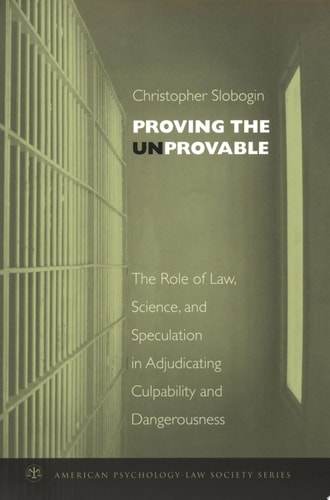
Proving the Unprovable: The Role of Law, Science, and Speculation in Adjudicating Culpability and Dangerousness
0
0
As an Amazon Associate and affiliate partner, Menrva Books earns from qualifying purchases. Learn more
Author Description
This book is written for researchers, scholars, advanced graduate students, and clinicians who work in risk assessment and criminal responsibility. It addresses the question of admitting expert testimony from behavioral health experts in determining matters of culpability and dangerousness by examining a number of factors, including the source of the expert testimony, whether juries need it, and whether it is presented as proven or informed in the court. It argues that the question cannot be understood as a dualistic matter of being for or against expert testimony; rather, its highly nuanced arguments show that determining who should be punished and who should be preventively detained must happen through an interdisciplinary process that looks at the specific circumstances of each case. It offers an analytic framework for making these determinations that treats culpability and dangerousness not as static, ontologically-complete entities, but rather as socially-constructed concepts that cannot be determined solely through the scientific method. The book makes the intriguing argument throughout that although expert testimony cannot be considered scientifically reliable or proven, it should nevertheless be included as long as it can be classified and understood as informed speculation because it makes legal factfinders attend more closely to the matters that the law considers pertinent to past mental states. It seeks to reconcile the tension between the law's demand for accuracy and the inability of behavioral science to provide more than speculative answers for most questions raised by the insanity defense and related doctrines and by sentencing, commitment and sex offender statutes that require determinations of risk.
Menrva's Summary
THE THESIS
How can the legal system effectively integrate behavioral health expert testimony when such evidence often lacks the precision of scientific proof? Christopher Slobogin, a prominent scholar in law and psychiatry, examines the intersection of behavioral science and judicial decision-making. He argues that culpability and dangerousness are socially constructed concepts rather than objective, measurable facts. The text proposes an analytical framework that treats expert testimony as informed speculation, advocating for its inclusion in courtrooms to sharpen the focus of legal factfinders on pertinent mental states.
THE SCOPE MAP
What You Will Find
- An analysis of the admissibility of behavioral health expert testimony in criminal proceedings.
- A framework for evaluating risk assessment and criminal responsibility in the context of the insanity defense.
- Examination of sentencing, civil commitment, and sex offender statutes requiring risk determinations.
- A critique of the tension between the legal demand for accuracy and the limitations of behavioral science.
THE AUTHORITY PERSPECTIVE
Legal scholars and forensic clinicians frequently cite this work as a foundational text for understanding the limitations of expert testimony in the courtroom. Experts highlight the book's nuanced approach to reconciling the inherent uncertainty of behavioral science with the rigid requirements of the justice system.
Page Count:
208
Publication Date:
2006-01-01
Publisher:
Oxford University Press
ISBN-10:
0198040962
ISBN-13:
9780198040965
Non-Fiction
Psychology
Forensic Science
Law
United States
Criminology
Community Tags
Similar Books