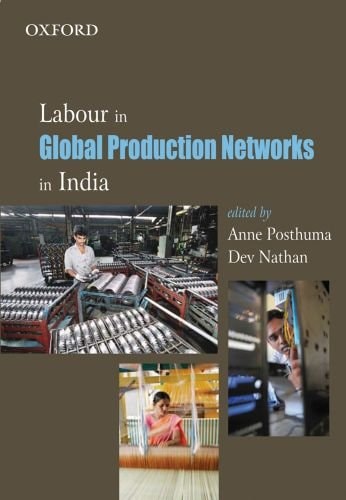
Labour in Global Production Networks
0
0
As an Amazon Associate and affiliate partner, Menrva Books earns from qualifying purchases. Learn more
Author Description
Since the advent of liberalization in India in 1991, much attention has been directed towards India's substantial economic growth rates, the pressures of globalisation on its labour market, and its potential role in the global economy in future. Though there have been studies on India's position in the global economy, relatively few studies have examined how engagement with global production networks is impacting upon companies and workers in India.This volume reveals that economic growth in India has created new opportunities for large and small firms, as well as new jobs for both highly-skilled workers and relatively low-skilled workers. However, the impact is uneven, even as opportunities for larger firms at the top of supply chains filter downwards. Moreover, economic upgrading does not necessarily translate into improved terms and conditions in the job, especially for workers embedded in lower tiers of global production networks. Instead, vulnerable jobs are on the rise for workers in the unorganised sector, and for some workers in the organised sector as well. With detailed sector-level studies spanning labour-intensive, skill-intensive and knowledge-intensive industries, this volume provides an analytical perspective on labour in an increasingly globalised economy. It further discusses how global production could be harnessed to yield better quality and more evenly-spread opportunities for firms and workers. Timely and topical, this book will appeal to scholars and researchers working on labour and employment studies, urban studies and gender studies; economists, political scientists, sociologists, administrators and policymakers, industry associations, and international institutions.
Menrva's Summary
THE THESIS
This volume investigates how integration into global production networks influences economic outcomes and labor conditions for workers and firms within the Indian economy. The authors, Anne Posthuma and Dev Nathan, utilize a comparative analytical framework to assess the disparity between economic growth and the quality of employment. By examining various industrial sectors, the text argues that while liberalization creates new opportunities, it simultaneously fosters uneven development and increases vulnerability for workers in lower tiers of the supply chain.
THE SCOPE MAP
What You Will Find
- Sector-level analysis covering labor-intensive, skill-intensive, and knowledge-intensive industries.
- An evaluation of the relationship between economic upgrading and actual job quality improvements.
- Empirical evidence regarding the rise of vulnerable employment in both organized and unorganized sectors.
- Policy-oriented discussions on harnessing global production for more equitable economic distribution.
THE AUTHORITY PERSPECTIVE
Experts and scholars in labor and development studies recognize this work as a significant contribution to understanding the complexities of the Indian labor market in a globalized context. Readers frequently note the analytical depth of the sector-specific studies, which provide a clear picture of the challenges faced by policymakers and industry stakeholders.
Page Count:
450
Publication Date:
2010-04-19
Publisher:
Oxford University Press
ISBN-10:
0198064136
ISBN-13:
9780198064138
Economics
Sociology
Globalization
Labor Market
International business
India
Labor Studies
Community Tags
Similar Books