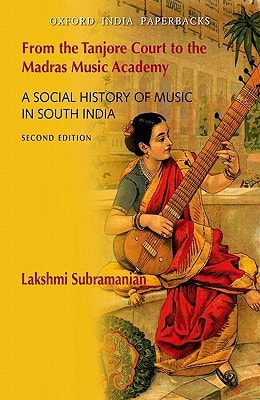
From the Tanjore Court to the Madras Music Academy: A Social History of Music in South India
0
0
As an Amazon Associate and affiliate partner, Menrva Books earns from qualifying purchases. Learn more
Author Description
This book traces the adaptation of the traditional music in south India, from the quiet courtyards of Tanjore to the concert halls of Madras, to the necessities of colonial and post-colonial social realities. An engaging narrative of the production of knowledge about music and the related institution-building process, the volume raises larger questions of identity and imagination. It discusses the influence of nationalism in the creation of an auditory habit as much as it shows how performance and patronage influenced the self-development of the consuming elite. Anticipating the dilemmas of the emerging modern Indian middle class, the author also explores the ambivalence and ambiguities that informed musical practices in the nineteenth and twentieth centuries. The second edition carries a new introduction which updates research on the subject and also discusses the new issues and trends emerging in the study of south Indian classical music.This book will interest students and scholars of history, music, sociology, ethnomusicology, cultural studies, south India, as well as informed general readers.
Menrva's Summary
THE THESIS
This work investigates how the transition of South Indian classical music from royal courts to public institutions reflects broader shifts in colonial and post-colonial identity. Lakshmi Subramanian, a historian specializing in the cultural history of India, utilizes archival research and institutional records to map the transformation of musical patronage. She argues that the professionalization of music was deeply intertwined with the development of a modern Indian middle-class identity and the influence of nationalist discourse.
THE SCOPE MAP
What You Will Find
- Historical analysis of the shift from Tanjore court patronage to the Madras Music Academy.
- Examination of how colonial social realities shaped the performance and consumption of classical music.
- Discussion of the role of nationalism in constructing an auditory habit for the Indian elite.
- Exploration of the ambiguities and dilemmas faced by the emerging middle class in the nineteenth and twentieth centuries.
THE AUTHORITY PERSPECTIVE
Scholars in ethnomusicology and South Asian history frequently cite this text as a foundational study on the institutionalization of Indian classical music. Readers often note the academic rigor of the prose, which provides a dense and well-researched framework for understanding the intersection of art and social power.
Page Count:
232
Publication Date:
2011-05-01
Publisher:
Oxford University Press
ISBN-10:
0198071906
ISBN-13:
9780198071907
History
Music
Politics And Culture
India
Sociology
Criticism history
Music Indic
Music
Community Tags
Similar Books