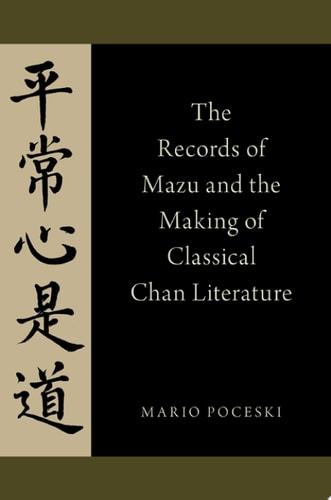
The Records of Mazu and the Making of Classical Chan Literature
0
0
As an Amazon Associate and affiliate partner, Menrva Books earns from qualifying purchases. Learn more
Author Description
The Records of Mazu and the Making of Classical Chan Literature explores the growth, makeup, and transformation of Chan (Zen) Buddhist literature in late medieval China. The volume analyzes the earliest extant records about the life, teachings, and legacy of Mazu Daoyi (709-788), the famous leader of the Hongzhou School and one of the principal figures in Chan history. While some of the texts covered are well-known and form a central part of classical Chan (or more broadly Buddhist) literature in China, others have been largely ignored, forgotten, or glossed over until recently.Poceski presents a range of primary materials important for the historical study of Chan Buddhism, some translated for the first time into English or other Western language. He surveys the distinctive features and contents of particular types of texts, and analyzes the forces, milieus, and concerns that shaped key processes of textual production during this period. Although his main focus is on written sources associated with a celebrated Chan tradition that developed and rose to prominence during the Tang era (618-907), Poceski also explores the Five Dynasties (907-960) and Song (960-1279) periods, when many of the best-known Chan collections were compiled.Exploring the Chan School's creative adaptation of classical literary forms and experimentation with novel narrative styles, The Records of Mazu and the Making of Classical Chan Literature traces the creation of several distinctive Chan genres that exerted notable influence on the subsequent development of Buddhism in China and the rest of East Asia.
Menrva's Summary
THE THESIS
This volume investigates how the evolution of Chan Buddhist literature in late medieval China was shaped by the life, teachings, and legacy of the influential monk Mazu Daoyi. Mario Poceski, a scholar of East Asian Buddhism, utilizes a rigorous historical framework to examine the textual production of the Hongzhou School. By analyzing both well-known and neglected primary sources, he argues that the development of Chan literature was a deliberate process of creative adaptation and stylistic innovation that defined the tradition's trajectory.
THE SCOPE MAP
What You Will Find
- Historical analysis of the Hongzhou School and Mazu Daoyi's influence
- Examination of textual production during the Tang, Five Dynasties, and Song periods
- Translations of primary materials previously unavailable in Western languages
- Study of the emergence of distinctive Chan literary genres
Scope Limits
- The text focuses primarily on written sources rather than oral traditions or archaeological artifacts
- It does not provide a comprehensive biography of Mazu Daoyi outside of his literary and institutional legacy
THE AUTHORITY PERSPECTIVE
Scholars and students of East Asian religion recognize this work as a significant contribution to the study of Chan textual history. Readers frequently note the academic density of the prose and the precision with which Poceski navigates complex primary source materials.
Page Count:
372
Publication Date:
2015-08-13
Publisher:
Oxford University Press
ISBN-10:
0190225750
ISBN-13:
9780190225759
Religion
History
Buddhism
Chan Buddhism
Criticism history
Literary Criticism
Asian Studies
Zen
Zen Buddhism
Community Tags
Other Editions(4)


Similar Books

Reader Comments
Share Your Thoughts
No comments yet. Be the first to share your thoughts!