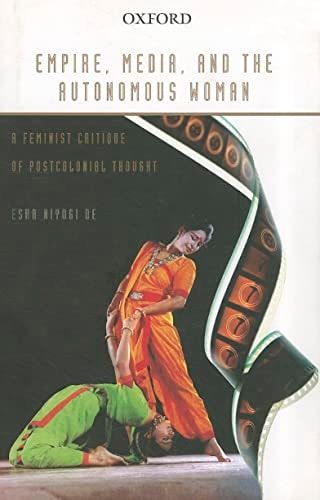
Empire, Media, and the Autonomous Woman: A Feminist Critique of Postcolonial Thought
0
0
As an Amazon Associate and affiliate partner, Menrva Books earns from qualifying purchases. Learn more
Author Description
Autonomy is commonly linked to liberal individualism, the Enlightenment philosophy which gives primacy to personal existence and interests rather than to the person's place in society and in history. Many see the autonomous individual as harbouring the possessive mentalities of western empire. In this work, Esha Niyogi De radically questions this foundational anti-Enlightenment position on which influential models of Postcolonial critique are based. She argues that the 'individual' has been creatively indigenized in non-western modernities: indigenous activist individuals attentive to empire and gender refuse possessive individualism while they invest in certain ethical premises of Enlightenment thought. De weaves her radical argument through a rich tapestry of gender portrayals drawn from two transitional moments of Indian modernity: the rise of humanism under colony and the influx of neoliberal capitalism. This book emphasizes the feminist challenge to sexual and racial orthodoxies posed by critical imaginations of the 'autonomous woman' in postcolonial cultures by studying autobiographical texts by nineteenth-century Bengali prostituted women; point-of-view photography; woman-centred dance dramas and essays by Rabindranth Tagore; representations of Tagore's works on mainstream television, video, and stage in India and Indian American diasporas; and feminist cinema, choreography and performance respectively by Aparna Sen and Manjusri Chaki-Sircar.
Menrva's Summary
THE THESIS
This work investigates whether the concept of the autonomous individual, often dismissed as a byproduct of Western imperialist philosophy, can be reinterpreted through a feminist lens within non-Western modernities. Esha Niyogi De, a faculty member in Women's Studies at the University of California, Los Angeles, challenges the prevailing postcolonial critique that equates autonomy solely with possessive individualism. By examining the intersection of gender, empire, and modernity in India, she argues that indigenous activists have successfully indigenized Enlightenment ethics to resist colonial and patriarchal orthodoxies.
THE SCOPE MAP
What You Will Find
- Analysis of nineteenth-century autobiographical texts by Bengali women.
- Examination of Rabindranath Tagore's dance dramas and essays.
- Evaluation of feminist cinema and choreography by Aparna Sen and Manjusri Chaki-Sircar.
- Comparative study of neoliberal capitalism and colonial humanism in India.
- Investigation into the representation of the autonomous woman in Indian and Indian American diasporic media.
THE AUTHORITY PERSPECTIVE
Scholars in postcolonial and gender studies view this text as a rigorous intervention into the debates surrounding Enlightenment thought and its reception in non-Western contexts. Readers frequently note the academic density of the prose, which provides a sophisticated framework for analyzing the intersection of performance, media, and political agency.
Page Count:
264
Publication Date:
2011-12-21
Publisher:
Oxford University Press
ISBN-10:
0198072554
ISBN-13:
9780198072553
Politics
Feminist Theory
Categories
Women india
Indian History
Liberalism
Gender Studies
Kindle eBooks
Criticism & Theory
Sociology
India
Kindle Store