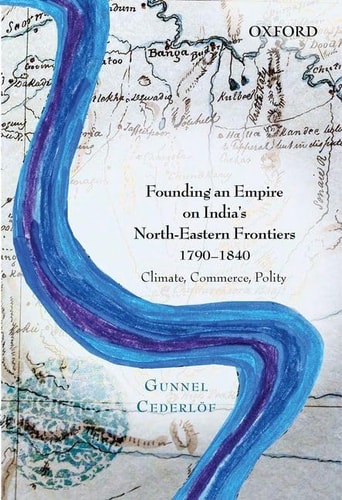
Founding an Empire on India's North-Eastern Frontiers, 1790-1840: Climate, Commerce, Polity
0
0
As an Amazon Associate and affiliate partner, Menrva Books earns from qualifying purchases. Learn more
Author Description
This study is a richly detailed historical work of the unsettled half-century from the 1790s to the 1830s when the British East India Company strove to establish control of the colonial north-eastern frontiers spanning the River Brahmaputra to the Burmese border. It offers a much-needed reframing of regional histories of South Asia away from the subcontinental Indian mainland to the varied social ecologies of Sylhet, Cachar, Manipur, Jaintia, and Khasi hills.As a mercantile corporation, the EIC aimed at getting in command of the millennium-old over-land commercial routes connecting India and China. The study specifically engages with the early nineteenth century explorations of trade across Burma. Simultaneously, the Mughal diwani grant compelled the EIC to govern territory. Drawing on extensive research, the study demonstrates the incompatibility of bureaucratic power, the complex socio-economic networks of authority, and the ever-changing landscapes of the region. In a monsoon climate, where rivers moved and land was inundated for months, any attempt to form a uniform administration tended to clash with hybrid landscapes and waterscapes. This work explores how daily administrative and military practice shaped colonial polities and subject formation.Located at the intersection of colonial, legal, and environmental history, the study is of particular interest for scholars and students in history, political ecology, and anthropology.
Menrva's Summary
THE THESIS
This study investigates how the British East India Company attempted to impose bureaucratic control over the volatile, monsoon-driven landscapes of India's north-eastern frontiers between 1790 and 1840. Gunnel Cederlof, a historian specializing in environmental and colonial history, utilizes extensive archival research to analyze the friction between imperial administrative ambitions and the complex, hybrid socio-ecological realities of regions like Sylhet, Cachar, and the Khasi hills. The work argues that the Company's efforts to secure commercial routes to China were fundamentally undermined by the region's shifting waterscapes and existing indigenous networks of authority.
THE SCOPE MAP
What You Will Find
- Analysis of the British East India Company's administrative and military expansion into the north-eastern frontier regions.
- Examination of the intersection between colonial governance and environmental challenges, specifically monsoon-driven landscape instability.
- Historical documentation of trade routes connecting India, Burma, and China during the early nineteenth century.
- A framework for understanding subject formation and the limits of bureaucratic power in hybrid colonial territories.
THE AUTHORITY PERSPECTIVE
Scholars in the fields of political ecology and South Asian history recognize this work as a significant contribution to the study of frontier governance and environmental history. Readers frequently note the academic rigor and the detailed archival research that Cederlof employs to challenge traditional subcontinental-centric historical narratives.
Page Count:
304
Publication Date:
2014-03-01
Publisher:
Oxford University Press
ISBN-10:
0198090579
ISBN-13:
9780198090571
History
India - History
Colonial History
Anthropology
Environmental History
Community Tags
Similar Books