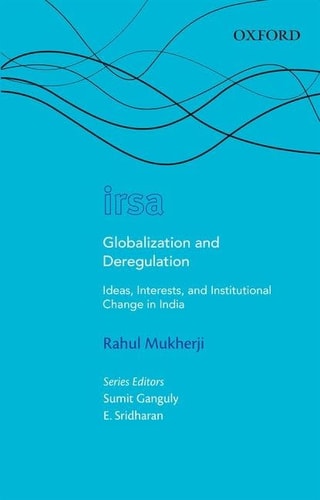
Globalization and Deregulation: Ideas, Interests, and Institutional Change in India
0
0
As an Amazon Associate and affiliate partner, Menrva Books earns from qualifying purchases. Learn more
Author Description
Globalization and Deregulation makes a contribution to the literature on economic change by exploring the institutional transition from state-led import substitution to deregulation and globalization in the world's most populous democracy-India. It proposes a largely internally driven 'tipping-point' model of economic change, which is in sharp contrast to the 'punctuated equilibrium' model of sudden exogenous shocks that drive transformations.Indian economists have provided excellent arguments about the need for change and have described changes that have occurred. This literature is essential for understanding how new economic ideas are born. But it does not explain the process of economic change, which is a political process.The best accounts of India's political economy explain why the institutions of government intervention within a closed economy were locked in a closed economy model. These accounts reveal why the dominant interest groups made political demands with substantial fiscal consequences. They do not engage with the issue of change. This book fills that gap by seriously engaging with India's economic history and the literature on institutional change. It is a contribution both to India's economic history and to systematic ways of thinking about economic change.
Menrva's Summary
THE THESIS
This book investigates the political processes and institutional mechanisms that facilitated India's transition from a state-led, closed economy to a globalized, deregulated market. Rahul Mukherji, a scholar of South Asian political economy, challenges the 'punctuated equilibrium' model by proposing an internally driven 'tipping-point' framework. He argues that economic transformation in India is not merely the result of exogenous shocks but is instead a complex political process shaped by evolving ideas and institutional shifts.
THE SCOPE MAP
What You Will Find
- A detailed analysis of India's economic transition from import substitution to deregulation.
- The 'tipping-point' model of institutional change as an alternative to sudden exogenous shock theories.
- Examination of the political economy behind government intervention and fiscal policy.
- A synthesis of historical economic data and institutional theory applied to the Indian context.
THE AUTHORITY PERSPECTIVE
Experts recognize this work as a significant contribution to the study of India's political economy and institutional history. Readers frequently note the academic rigor of the prose, which provides a structured framework for understanding how domestic political interests drive national economic policy.
Page Count:
280
Publication Date:
2014-08-05
Publisher:
Oxford University Press
ISBN-10:
0198096178
ISBN-13:
9780198096177
Economics
History
India
Globalization
Deregulation
Community Tags
Similar Books