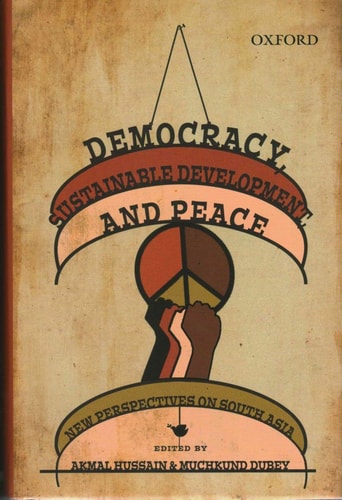
Democracy, Sustainable Development, and Peace: New Perspectives on South Asia
0
0
As an Amazon Associate and affiliate partner, Menrva Books earns from qualifying purchases. Learn more
Author Description
This book examines in the context of South Asia, four inter related dimensions that constitute the central policy challenges of our time: consolidating democracy, confronting violent extremism, overcoming mass poverty, and addressing the challenge of climate change. These dimensions are explored at the country-specific as well as the regional level, by some of the leading scholars and eminent public figures from the region, and interconnected by the editors through a new perspective.Consolidating democracy in societies with varying degrees of hierarchical rigidity requires governments to give space to civil society and provide institutional access to the under-privileged strata of society over governance decisions that affect their life. Such empowerment requires rapid poverty reduction through inclusive growth and creation of high wage employment. Apart from currently exclusive institutional structures in the economies of South Asia, a major hurdle in achieving inclusive growth is climate change, which has a relatively greater adverse effect on the poor. Mitigation and adaptation measures in the face of climate change require regional cooperation in South Asia for joint water shed management, improved efficiency of irrigation and water use, development of heat-resistant varieties of food grains, and developing decentralized food stock silos to give quick access over food grain to the people in case of severe shortages. This requires cooperation and coordinated policy efforts among South Asian countries. The editors advocate that a prerequisite for such efforts is a new approach based on inter-state peace and cooperation that could facilitate the establishment within individual nation states of institutional links between democratic structures, development initiatives, managing violence and conserving the environment.
Menrva's Summary
THE THESIS
This book investigates the complex interplay between democratic consolidation, economic development, and regional peace within the specific context of South Asia. Editors Akmal Hussain and Muchkund Dubey assemble a collection of essays from prominent regional scholars to argue that sustainable development is inextricably linked to institutional reform, poverty alleviation, and climate change mitigation. The text posits that individual nation-state stability in South Asia depends upon a new framework of regional cooperation that bridges the gap between democratic governance and the needs of underprivileged populations.
THE SCOPE MAP
What You Will Find
- Analysis of the four primary policy challenges: democracy, extremism, poverty, and climate change.
- Country-specific case studies contrasted with regional-level policy frameworks.
- Methodologies for inclusive growth and high-wage employment creation.
- Strategies for regional cooperation regarding water management, food security, and climate adaptation.
THE AUTHORITY PERSPECTIVE
Experts identify this work as a significant contribution to South Asian policy studies, noting its comprehensive approach to interconnected regional crises. The text is frequently cited for its practical focus on institutional reform and its clear articulation of the necessity for cross-border cooperation in the face of environmental and economic instability.
Page Count:
552
Publication Date:
2014-05-06
Publisher:
Oxford University Press
ISBN-10:
0198092342
ISBN-13:
9780198092346
Economics
Government - Asia
South Asia
International relations
Climate Change
Community Tags
Similar Books