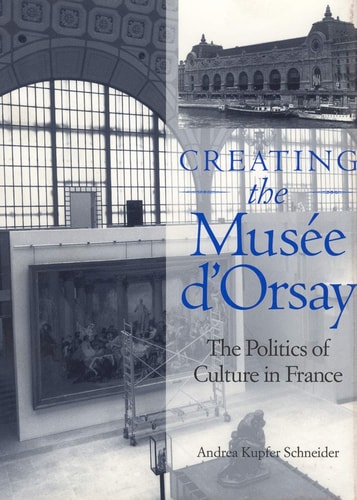
Creating the Musée d'Orsay: The Politics of Culture in France
0
0
As an Amazon Associate and affiliate partner, Menrva Books earns from qualifying purchases. Learn more
Author Description
The Gare d'Orsay train station, designed by French architect Victor Laloux, opened in Paris in 1900 to much fanfare. In fact, it was so beautiful that the French painter Edouard Détaille felt it would be more appropriate as a museum. Eighty-six years later, after a complex and controversial decision-making process, the French government finally transformed the station into the Musée d'Orsay, now one of the most dramatic and popular museums in Paris. This concise book presents the fascinating history of the creation of the Musée d'Orsay and the battles among the prominent politicians, curators, and historians over the architecture, collections, and concept of the museum. Relying primarily on interviews and contemporary newspaper articles, Andrea Schneider uses her expertise in decision-making analysis to uncover a story that reveals the true power of the curatorial elite. The book focuses on the powerful role of the government in the French art world—a role that may seem remarkable to most Americans. The book also provides insight into the zealous, and often amusing, viewpoints of the French public, art critics, and politicians. Battle lines were drawn over many questions: Should a nineteenth-century building be saved or destroyed? Should its interior be decorated in a Beaux-Arts style or in a modern design? What period should the museum encompass? Should both academic and avant-garde art be shown in the museum? How should it be organized? Is the museum concerned with the elite or the masses, with high culture or popular culture? Should there be history in an art museum? The story behind the compromises that resulted is fascinating for what it reveals about the interaction of power and culture in French society.
Menrva's Summary
THE THESIS
The transformation of a Parisian train station into a world-renowned museum was a battleground of cultural and political ideologies. Andrea Kupfer Schneider, an expert in decision-making analysis, details the complex and controversial process behind the creation of the Musée d'Orsay. Drawing on interviews and contemporary newspaper articles, the book examines the fierce debates among politicians, curators, and historians regarding the building's architecture, its collections, and its conceptualization. The narrative highlights the significant influence of the French government and the curatorial elite on the art world, contrasting with American perspectives and revealing the passionate, often amusing, viewpoints of the French public and critics.
THE SCOPE MAP
- The history of the Gare d'Orsay train station and its transformation into the Musée d'Orsay.
- Analysis of the political and cultural battles surrounding the museum's creation.
- Examination of debates on architectural style (Beaux-Arts vs. modern design) and preservation.
- Discussion of curatorial decisions regarding the museum's scope and collection focus.
- Insights into the power dynamics between government, art institutions, and the public in France.
- Case studies of decision-making processes in cultural institutions.
- The role of contemporary newspaper articles and interviews as primary sources.
THE AUTHORITY PERSPECTIVE
The book is regarded as a detailed examination of the political and cultural forces that shaped the Musée d'Orsay. Its strength lies in Schneider's application of decision-making analysis to historical events, utilizing interviews and contemporary media to illuminate the complex negotiations involved. The work offers a unique perspective on the French art world and the significant governmental influence within it. It provides an engaging look at the passionate debates that defined the museum's identity and its place in French society.
Page Count:
160
Publication Date:
1998-07-02
Publisher:
Penn State University Press
ISBN-10:
027101752X
ISBN-13:
9780271017525
Non-Fiction
History
Museum Studies
Art History
French History
Community Tags
Similar Books