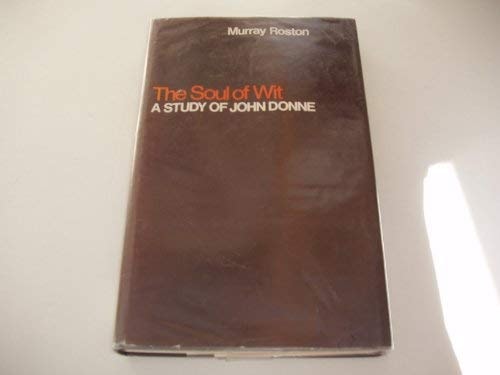
The Soul of Wit: A Study of John Donne
0
0
As an Amazon Associate and affiliate partner, Menrva Books earns from qualifying purchases. Learn more
Author Description
The Soul of Wit demonstrates the unity of experience in Donne's poetry, and suggests that despite all surface differences, there exists an underlying affinity between the 'libertine' or amatory poems and the devotional writings. The unifying impulse is traced to Donne's dissatisfaction with certain Renaissance modes of thought and his attempt to resist or negate them. In applying this reading to the major poems, the author broadens the cultural context to include such Mannerist artists as El Greco, Tintoretto, and Caravaggio, who are seen as sharing many of Donne's own philosophical and aesthetic concerns, and as offering valuable insights into the 'metaphysical' quality of his verse.
Menrva's Summary
THE THESIS
This study investigates the underlying unity between John Donne's amatory poetry and his devotional writings by identifying a shared philosophical resistance to Renaissance modes of thought. Murray Roston, a scholar of English literature, utilizes a comparative framework to bridge the gap between Donne's secular and religious works. By examining the poet's dissatisfaction with contemporary intellectual norms, Roston argues that a singular aesthetic impulse drives the entirety of Donne's creative output.
THE SCOPE MAP
What You Will Find
- A comparative analysis of Donne's 'libertine' poetry and his later devotional verse.
- A cultural contextualization linking Donne's work to Mannerist painters such as El Greco, Tintoretto, and Caravaggio.
- An examination of the 'metaphysical' quality of verse as a reaction against Renaissance aesthetic constraints.
- A thematic study of the intellectual and philosophical tensions present in seventeenth-century literature.
THE AUTHORITY PERSPECTIVE
Scholars frequently cite this work for its innovative application of art history to the study of metaphysical poetry. It is considered a significant text for those interested in the interdisciplinary connections between Renaissance literature and Mannerist visual arts.
Page Count:
236
Publication Date:
1974-01-01
Publisher:
Clarendon Press
ISBN-10:
0198120532
ISBN-13:
9780198120537
Poetry
Biography
Renaissance
Art History
Literary Criticism
Community Tags
Similar Books