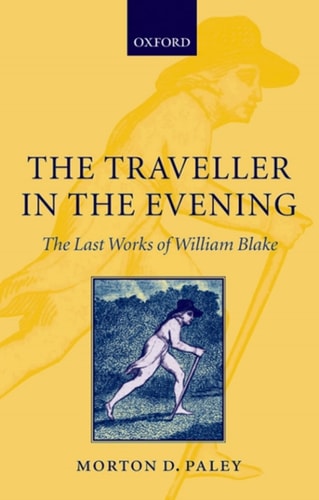
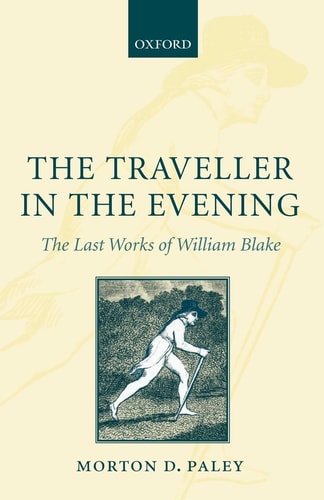
The Traveller in the Evening: The Last Works of William Blake
0
0
As an Amazon Associate and affiliate partner, Menrva Books earns from qualifying purchases. Learn more
Author Description
There has never been a book about Blake's last period, from his meeting with John Linnell in 1818 to his death in 1827, although it includes some of his greatest works. In The Traveller in the Evening, Morton Paley argues that this late phase involves attitudes, themes, and ideas that are either distinctively new or different in emphasis from what preceded them. After an introduction on Blake and his milieu during this period, Paley begins with a chapter on Blake's illustrations to Thornton's edition of Virgil. Paley relates these to Blake's complex view of pastoral, before proceeding to a history of the project, its near-abortion, and its fulfillment as Blake's one of greatest accomplishments as an illustrator. In Yah and His Two Sons the presentation of the divine, except where it is associated with art, is ambiguous where it is not negative. Paley takes up this separate plate in the context of artists's representations of the Laocoön that would have been known to Blake, and also of what Blake would have known of its history from classical antiquity to his own time. Blake's Dante water colours and engravings are the most ambitious accomplishment of the last years of his life, and Paley shows that the problematic nature of some of these pictures, with Beatrice Addressing Dante from the Car as a main example, arises from Blake's own divided and sharply polarized attitude toward Dante's Comedy. The closing chapter, called 'Blake's Bible', is on the Bible-related designs and writings of Blake's last years. Paley discusses The Death of Abel (addressed to Lord Byron 'in the Wilderness') as a response to its literary forerunners, especially Gessner's Death of Abel and Byron's Cain. For the Job engravings Paley shows how the border designs and the marginal texts set up a dialogue with the main illustrations unlike anything in Blake's Job water colours on the same subjects. Also included here are Blake's last pictorial work on a Biblical subject, The Genesis manuscript, an
Menrva's Summary
THE THESIS
This work investigates the distinct thematic and stylistic evolution of William Blake's artistic output during the final decade of his life, from 1818 to 1827. Morton D. Paley, a distinguished scholar of Romanticism, utilizes primary source documents, correspondence, and an exhaustive analysis of Blake's late engravings and watercolours to argue that this period represents a unique phase of creative maturity. By situating these works within the context of Blake's personal milieu and his interactions with contemporaries like John Linnell, Paley demonstrates how Blake's late-life philosophy diverged from his earlier artistic concerns.
THE SCOPE MAP
What You Will Find
- Analysis of Blake's illustrations for Thornton's Virgil and the Dante watercolours.
- Examination of the Laocoön plate in relation to classical antiquity and contemporary artistic discourse.
- Critical study of the Job engravings and their unique marginal dialogue.
- Discussion of Blake's engagement with Biblical themes and literary responses to Byron and Gessner.
Scope Limits
- The text does not provide a comprehensive biography of Blake's entire life, focusing strictly on the 1818–1827 period.
- It does not offer a general introduction to Blake's earlier mythological systems or early poetry.
THE AUTHORITY PERSPECTIVE
Scholars and art historians frequently cite this text as a foundational study for understanding the complexities of Blake's final creative years. Readers note the academic density of the prose, which assumes a high level of familiarity with Blake's visual and literary canon.
Page Count:
332
Publication Date:
2007-01-01
Publisher:
OUP Oxford
ISBN-10:
0191527815
ISBN-13:
9780191527814
Biography
Poetry
Non-Fiction
English
Art History
English & College Success
British literature
Literary Criticism
Community Tags
Other Editions(2)
Similar Books




Reader Comments
Share Your Thoughts
No comments yet. Be the first to share your thoughts!