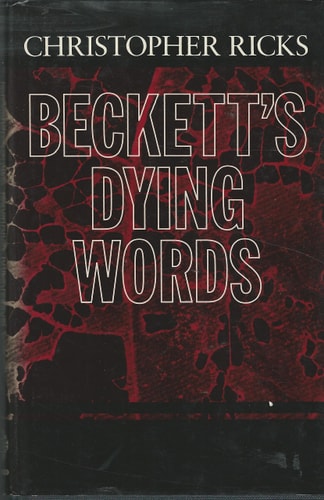
Beckett's Dying Words: The Clarendon Lectures 1990
0
0
As an Amazon Associate and affiliate partner, Menrva Books earns from qualifying purchases. Learn more
Author Description
Most people want to live forever. But there is another truth: the longing for oblivion. With pain, wit, and humor, the art of Samuel Beckett variously embodies this truth, this ancient enduring belief that it is better to be dead than alive, best of all never to have been born. Beckett is the supreme writer of an age which has created new possibilities and impossibilities even in the matter of death and its definition--an age of transplants and life-support.But how does a writer give life to dismay at life itself, to the not unwelcome encroachments of death, when it is for the life, the vitality of their language that we value writers? Beckett became himself as a writer when he realized in his very words a principle of death: in clichés, which are dead but won't lie down; in a dead language and its memento mori; in words which mean their own opposites, like cleaving; and in what Beckett called a syntax of weakness.This artful study explores the relation between deep convictions about life or death and the incarnations which these take in the exact turns of a great writer, the realizations of an Irishman who wrote in English and in French, two languages with different apprehensions of life and of death.
Menrva's Summary
THE THESIS
This work investigates how Samuel Beckett’s literary output reflects a profound preoccupation with the desire for oblivion and the philosophical preference for non-existence. Christopher Ricks, a renowned literary critic, examines the paradox of a writer who uses the vitality of language to express a fundamental dismay at life itself. By analyzing Beckett’s linguistic choices, Ricks argues that the author’s transition into his mature style was defined by the integration of death-like qualities into his syntax and vocabulary. The study provides a rigorous framework for understanding how Beckett’s bilingualism and use of clichés serve as memento mori within his creative body of work.
THE SCOPE MAP
What You Will Find
- Analysis of Beckett’s linguistic techniques, including the use of dead metaphors and contradictory word meanings.
- Examination of the tension between Beckett’s Irish heritage and his dual-language writing in English and French.
- Exploration of the philosophical concept of the 'longing for oblivion' in modern literature.
- Detailed study of the 'syntax of weakness' as a stylistic device to convey existential exhaustion.
THE AUTHORITY PERSPECTIVE
Scholars and critics frequently cite this text as a foundational analysis of Beckett’s stylistic evolution and his unique relationship with language. Readers often note the academic density of the prose, which demands a high level of familiarity with Beckett’s primary texts to fully appreciate the critical arguments presented.
Page Count:
224
Publication Date:
1993-08-26
Publisher:
Oxford University Press
ISBN-10:
0198123582
ISBN-13:
9780198123583
Non-Fiction
Philosophy
Biography
In literature
Literary Criticism
Community Tags
Similar Books