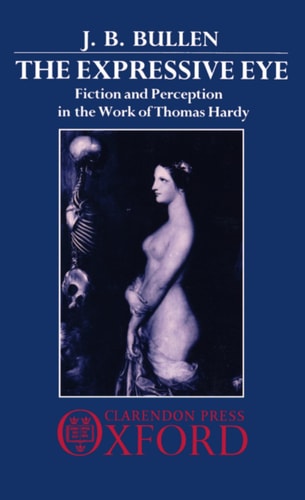
The Expressive Eye: Fiction and Perception in the Work of Thomas Hardy
0
0
As an Amazon Associate and affiliate partner, Menrva Books earns from qualifying purchases. Learn more
Author Description
Each of Thomas Hardy's novels is filled with striking visual images -- characters, interior settings, buildings, village scenes, and open tracts of land. These images are all rendered with a vitality and energy immediately recognizable as Hardy's own. In fact, Hardy, whose style owed much to his abilities as a draughtsman, once remarked that he saw his narratives as a series of images. J. B. Bullen explores this fascinating link between the image and the idea in the fiction of Thomas Hardy, and demonstrates how Hardy approached his work from a particular "point of view" which not only determined the lighting, composition, and structure of his literary visual effects, but which also allowed him to express emotions and ideas in the direct, "vividly visible" fashion that is the hallmark of his greatest fiction.
Menrva's Summary
THE THESIS
This book investigates the fundamental connection between Thomas Hardy's background as a draughtsman and the highly visual, image-driven nature of his literary narratives. J. B. Bullen, a scholar of Victorian literature and art, examines how Hardy’s training in architectural drawing influenced his prose style. By analyzing the lighting, composition, and structural elements within Hardy's novels, the author argues that the novelist’s unique "point of view" was a deliberate artistic strategy used to externalize complex emotions and philosophical ideas through vivid, concrete imagery.
THE SCOPE MAP
What You Will Find
- An analysis of Hardy's novels through the lens of visual art and architectural composition.
- A study of the relationship between Hardy's early career as a draughtsman and his later literary techniques.
- Examination of specific visual motifs including interior settings, landscapes, and character portraits.
- A framework for understanding how literary "lighting" and "composition" function to convey thematic depth.
THE AUTHORITY PERSPECTIVE
Scholars and critics frequently cite this work as a foundational text for understanding the intersection of visual arts and Victorian narrative technique. Readers often note the academic density of the prose, which provides a rigorous examination of Hardy's aesthetic development.
Page Count:
304
Publication Date:
1986-05-01
Publisher:
Oxford University Press
ISBN-10:
0198128584
ISBN-13:
9780198128588
History
Biography
In literature
Literary Criticism
Art History
English literature
Community Tags
Similar Books