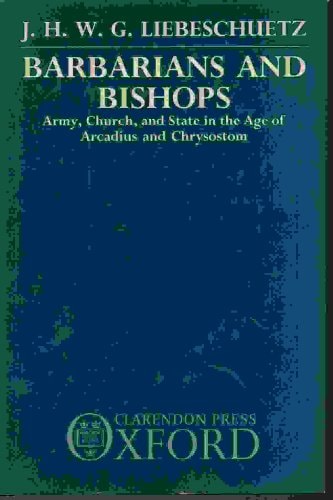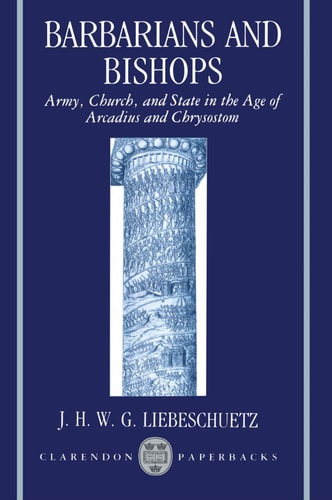
Barbarians and Bishops: Army, Church, and State in the Age of Arcadius and Chrysostom
0
0
As an Amazon Associate and affiliate partner, Menrva Books earns from qualifying purchases. Learn more
Author Description
In this illuminating study Liebeschuetz examines two fundamental themes of Late Antiquity: the barbarization of the Roman army and the interrelation of Church and secular government. He discusses Alaric's Goths in the West, who were treated as a federate regiment rather than a migrating tribe; how the civilian authorities at Constantinople maintained control over the largely German army in a conflict that culminated in the Gainas rising; and how the same authorities came into conflict with John Chrysostom, the bishop of Constantinople, and had him deposed.
Menrva's Summary
THE THESIS
This work investigates how the Roman Empire navigated the dual pressures of a barbarized military and an increasingly influential Church during the reign of Arcadius. J. H. W. G. Liebeschuetz, a scholar of Late Antiquity, utilizes primary source accounts and administrative records to analyze the political instability of the Eastern Roman Empire. He argues that the civilian government's struggle to manage German federate troops and the subsequent friction with ecclesiastical figures like John Chrysostom were defining features of the era's systemic decline. The text provides a framework for understanding the erosion of traditional Roman authority in the face of internal and external institutional shifts.
THE SCOPE MAP
What You Will Find
- Analysis of the integration of Alaric's Goths into the Roman military structure as federate regiments.
- Examination of the political crisis surrounding the Gainas rising and civilian control over the army.
- Investigation into the power struggle between the imperial court and the bishopric of Constantinople.
- Historical assessment of the deposition of John Chrysostom as a case study in Church-State relations.
THE AUTHORITY PERSPECTIVE
Historians and classicists frequently cite this text as a rigorous examination of the administrative complexities inherent in the late Roman state. Experts highlight the author's ability to synthesize military history with ecclesiastical politics, making it a foundational resource for students of the period.
Page Count:
336
Publication Date:
1992-03-05
Publisher:
Clarendon Press
ISBN-10:
0198140738
ISBN-13:
9780198140733
History
Church History
Late Antiquity
Byzantine History
Roman Empire
Ancient History
Military History