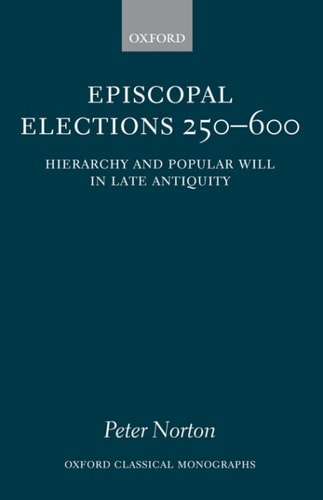
Episcopal Elections 250-600: Hierarchy and Popular Will in Late Antiquity
0
0
As an Amazon Associate and affiliate partner, Menrva Books earns from qualifying purchases. Learn more
Author Description
Peter Norton covers a topic of great relevance to students of early Church history and late antiquity alike. He challenges the conventional view that after the adoption of Christianity by the Roman empire the local community lost its voice in the appointment of bishops, and argues that this right remained in theory and practice for longer than is normally assumed. Given that bishops became important to the running of the empire at the local level, a proper understanding of how they came into office is essential for our understanding of the later empire.
Menrva's Summary
THE THESIS
This work investigates the evolution of episcopal election processes in the early Church, specifically challenging the assumption that the influence of the local laity diminished immediately following the Christianization of the Roman Empire. Peter Norton, a scholar of late antiquity, utilizes a comprehensive analysis of primary source material and historical records to argue that the popular will remained a significant factor in the appointment of bishops well into the sixth century. He posits that the continued involvement of the local community was not merely a theoretical ideal but a functional reality that shaped the administrative and social landscape of the later empire.
THE SCOPE MAP
What You Will Find
- Analysis of election procedures between 250 and 600 AD
- Examination of the interplay between imperial authority and local ecclesiastical autonomy
- Case studies of specific episcopal appointments across various regions of the empire
- Evaluation of the role of the clergy, the local elite, and the general populace in selection processes
Scope Limits
- Does not provide a comprehensive history of the entire Roman administrative system
- Focuses primarily on the mechanics of election rather than the theological debates of the era
THE AUTHORITY PERSPECTIVE
Scholars and historians frequently cite this text as a rigorous correction to traditional narratives regarding the centralization of Church power. Readers often note the academic density of the prose, which serves as a foundational resource for those studying the intersection of Roman governance and early Christian institutional development.
Page Count:
288
Publication Date:
2007-01-01
Publisher:
Oxford University Press
ISBN-10:
0191525871
ISBN-13:
9780191525872
History
Religion
Bishops
Ecclesiastical History
Roman Empire
Ancient History
Late Antiquity
Church History
Community Tags
Similar Books