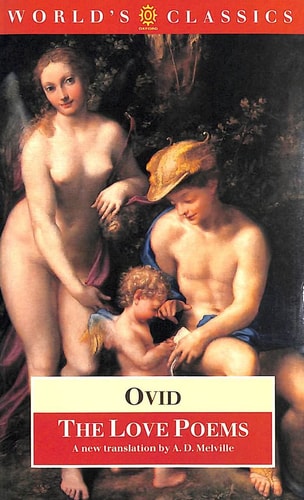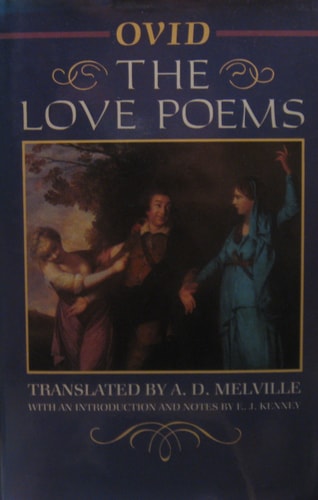
The Love Poems
0
0
As an Amazon Associate and affiliate partner, Menrva Books earns from qualifying purchases. Learn more
Author Description
Ovid's love poetry, like everything else he wrote, was original and innovative. Yet under the surface of the poet's characteristic wit runs an undercurrent of serious meaning--the theme of the poet's complete control of his medium and his art and a proud consciousness of achievements registered and yet to come. Ovid claimed to be the "Virgil of elegy" and in such poetry as Amores, Ars Amatoria and Remedia Amoris, he largely succeeded. These accomplished translations of the love poetry adopt a highly entertaining modern idiom, yet maintain the sophisticated elegance of Ovid's Latin. Melville, the acclaimed translator of the Metamorphoses, employs rhyme throughout and evolves an original metrical system that gives a greater sense of Ovid's elegaic couplets than earlier systems. He also includes, with some revisions, B.P. Moore's brilliant version of Ars Amatoria, published over fifty years ago and still unequalled.
Menrva's Summary
THE PULSE
Ovid explores the complexities of desire, courtship, and the art of seduction through the lens of classical elegy. The poet positions himself as a master of his craft, navigating the delicate balance between playful wit and the serious implications of romantic pursuit. Through a series of verses, he examines the power dynamics inherent in love, utilizing the framework of the elegiac couplet to comment on both personal passion and the nature of poetic creation. The work functions as a guide to the rituals of attraction, reflecting the social and cultural constraints of the Roman era while maintaining a focus on the poet's own artistic agency.
INSIDE THE PAGES
- Utilization of the elegiac couplet form to structure romantic discourse.
- Exploration of the didactic nature of love and courtship rituals.
- Integration of wit and irony to subvert traditional romantic tropes.
- Focus on the poet's self-conscious role as an arbiter of desire.
- Examination of the tension between public performance and private emotion.
- Use of mythological allusions to ground contemporary romantic experiences.
- Emphasis on the artifice of seduction as a deliberate creative act.
- Incorporation of sophisticated metrical systems to mirror original Latin rhythms.
THE COLLECTIVE ECHO
Readers and critics frequently highlight the enduring relevance of Ovid's wit and his ability to modernize classical themes for contemporary audiences. Discussion often centers on the translator's choice to employ rhyme and original metrical structures, which some argue captures the elegance of the original Latin more effectively than previous attempts. The balance between the playful, often cynical tone of the advice and the underlying technical mastery of the verse remains a primary point of analysis. Scholars often note that the collection serves as a foundational text for understanding the evolution of erotic poetry in Western literature. The work is widely regarded as a significant achievement in translating ancient sensibilities into a readable, modern idiom.
Page Count:
304
Publication Date:
1990-03-08
Publisher:
Oxford University Press
ISBN-10:
0198147627
ISBN-13:
9780198147626
Romance
Poetry
Classical
Love Poetry
Latin