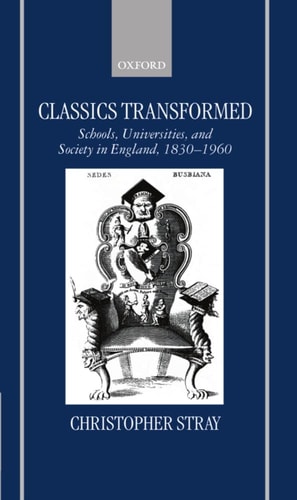
Classics Transformed: Schools, Universities, and Society in England, 1830-1960
0
0
As an Amazon Associate and affiliate partner, Menrva Books earns from qualifying purchases. Learn more
Author Description
This is the first book to give a general account of the transformation of classics in English schools and universities from being the amateur knowledge of the Victorian gentleman to that of the professional scholar, or from an elite social marker to a marginalized academic subject. The challenges to the authority of classics in 19th-century England are analyzed, as are the many and various ideological responses of its practitioners. The impact of university reform on the content and organization of classical knowledge is described in detail, with special reference to Cambridge. Chapters are devoted to the effects of state intervention, social snobbery, and democracy on the provision of classics in schools, and the dissensions within the bodies set up to defend it. The narrative runs clear up to the present, fully covering along the way the abolition of Compulsory Latin in 1960 and the absence of classics from the National Curriculum in 1988.
Menrva's Summary
THE THESIS
This book investigates the historical transformation of classical studies in England from a foundational marker of elite social status to a specialized academic discipline. Christopher Stray, a noted historian of classical education, utilizes archival records and institutional histories to map the shifting pedagogical and social landscape of the 19th and 20th centuries. He argues that the professionalization of the field was a reactive process, shaped by university reform, state intervention, and the broader democratization of the English educational system.
THE SCOPE MAP
What You Will Find
- A detailed historical analysis of the transition from amateur gentlemanly knowledge to professional scholarship.
- Examination of the impact of university reform on classical curricula, with a specific focus on the University of Cambridge.
- Analysis of the socio-political pressures, including social snobbery and democratic shifts, that influenced the decline of classics in schools.
- A comprehensive timeline covering the abolition of Compulsory Latin in 1960 and the subsequent exclusion of classics from the 1988 National Curriculum.
THE AUTHORITY PERSPECTIVE
Scholars and historians of education frequently cite this work as a foundational text for understanding the institutional history of the humanities in Britain. Readers often note the academic density of the prose, which provides a rigorous and exhaustive account of the subject matter.
Page Count:
352
Publication Date:
1998-05-14
Publisher:
Clarendon Press
ISBN-10:
019815013X
ISBN-13:
9780198150138
History
Education
Sociology
Great Britain
British History
Academic
Community Tags
Similar Books