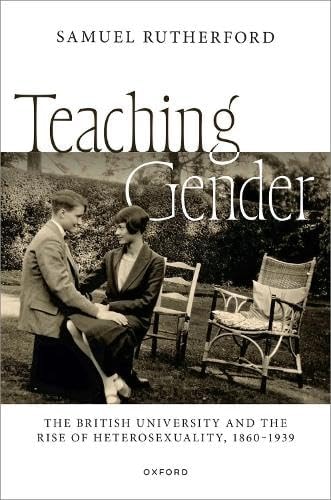
Teaching Gender: The British University and the Rise of Heterosexuality, 1860–1939
0
0
As an Amazon Associate and affiliate partner, Menrva Books earns from qualifying purchases. Learn more
Author Description
In Britain in the late nineteenth and early twentieth centuries, universities were one of many institutional state structures wherein gender difference, the male breadwinner ideal, and heterosexuality were central to a conception of citizenship. But while the state could enforce these norms through the parameters it set on the extension franchise or the distribution of welfare benefits, individual women and men also played active roles in creating and renegotiating them through the messy interactions of everyday life.Teaching Gender immerses the reader in lecture theatres, University Senate meetings, student unions, nightclubs, and halls of residence to show how individuals' efforts to find workable paradigms for relating to one another across gender lines took shape within specific institutional, political, and financial constraints, and in the context of a historical moment when anxiety accrued around non-normative genders and sexualities as symptomatic of wider social and political instability. Drawing on extensive research in the archives of ten colleges and universities across England and Scotland, Samuel Rutherford shows that the nationalization and centralization of higher education at the turn of the twentieth century resulted incidentally in coeducation, over the protest of feminist activists who supported gender segregation; that students' negotiation of cross-gender interaction in coeducational universities ultimately led them to identify heterosexuality as a seemingly less fraught paradigm than more gender-neutral conceptions of 'corporate life'; and that single-sex men's and women's colleges, though increasingly marginal, became important sites for the theorization of life paths and identities outside the heterosexual norm. Through detailed recovery both of political and financial decision-making and of the experiences and emotions of faculty, students, administrators, donors, and national politicians, Rutherford paints a vivid and resonant picture of the development of modern gender norms.
Menrva's Summary
THE THESIS
How did the institutionalization of British higher education between 1860 and 1939 shape the development of heterosexuality as a normative social and political construct? Samuel Rutherford, a historian of modern Britain, utilizes archival records from ten universities across England and Scotland to examine the intersection of state policy and individual agency. He argues that the centralization of the university system inadvertently fostered coeducation, which in turn prompted students and faculty to adopt heterosexuality as a stabilizing paradigm amidst broader societal anxieties regarding non-normative gender roles.
THE SCOPE MAP
What You Will Find
- Archival analysis of ten colleges and universities across England and Scotland.
- Examination of the transition from gender-segregated education to coeducational models.
- Investigation into the role of student unions, halls of residence, and senate meetings in social formation.
- Analysis of how political and financial constraints influenced the construction of gendered citizenship.
THE AUTHORITY PERSPECTIVE
Scholars in the fields of gender history and the history of education recognize this work for its rigorous archival methodology and its focus on the institutional mechanisms of social normativity. Readers frequently note the dense, academic nature of the prose, which provides a detailed look at the intersection of administrative policy and personal identity formation.
Page Count:
272
Publication Date:
2025-07-17
Publisher:
Oxford University Press
ISBN-10:
0198937490
ISBN-13:
9780198937494
Politics
History
Sociology
Gender Studies
Education
Europe
LGBTQ Studies
British History
Academic
Community Tags
Similar Books











Reader Comments
Share Your Thoughts
No comments yet. Be the first to share your thoughts!