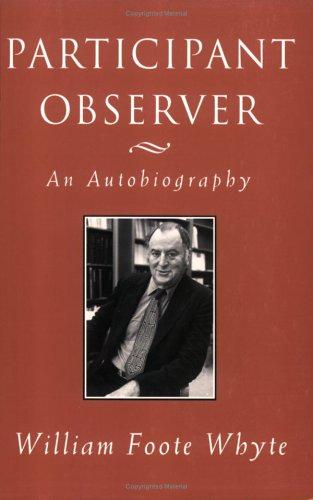
Participant Observer
0
0
As an Amazon Associate and affiliate partner, Menrva Books earns from qualifying purchases. Learn more
Author Description
What would happen if a social scientist saw himself not as an outsider but as a participant, engaging in the situations he studied and acting to change the course of events? The distinguished career of William Foote Whyte as an activist scholar provides a rich and complex answer to that question. Participant Observer is Whyte's own story. He takes us to worksites from Boston's North End in the early forties to Spain and Peru in the seventies to Jamestown, New York, in the eighties. Along the way, we see the development of his thinking and the spread of his influence into fields as disparate as social psychology, industrial relations, and agricultural development. While it documents a remarkable career, Participant Observer is also a personal chronicle. Whyte reflects with candor and sometimes great amusement on the years of his childhood, his academic education, and his marriage. He also describes being stricken with polio and recounts how he and his family worked to circumvent the handicaps the disease dealt him. Beginning with his study of neighborhood gangs in Boston's North End and moving into such diverse workplaces as the oil fields of Oklahoma, the dining rooms of Stouffer's, and rural villages in Peru, Whyte's research has focused on connections between social organization and human performance. Whyte listened to what workers told him, gave their views weight in his recommendations to decision makers, and eventually became a powerful voice for greater worker participation and workplace democracy. His work is a model for the social sciences and his story should be read by any serious student of them.
Menrva's Summary
THE THESIS
William Foote Whyte's career as an activist scholar is chronicled, exploring his development as a social scientist who engaged directly with his subjects and influenced their environments. The book details Whyte's fieldwork across diverse locations and decades, from Boston's North End to Spain and Peru, illustrating the evolution of his thinking on social organization and human performance. It also serves as a personal memoir, recounting his childhood, education, marriage, and his resilience in overcoming polio. Whyte's research consistently focused on the link between social structures and performance, advocating for worker participation and workplace democracy.
THE SCOPE MAP
- What would happen if a social scientist saw himself not as an outsider but as a participant, engaging in the situations he studied and acting to change the course of events?
- The distinguished career of William Foote Whyte as an activist scholar provides a rich and complex answer to that question.
- Participant Observer is Whyte's own story.
- He takes us to worksites from Boston's North End in the early forties to Spain and Peru in the seventies to Jamestown, New York, in the eighties.
- Along the way, we see the development of his thinking and the spread of his influence into fields as disparate as social psychology, industrial relations, and agricultural development.
- While it documents a remarkable career, Participant Observer is also a personal chronicle.
- Whyte reflects with candor and sometimes great amusement on the years of his childhood, his academic education, and his marriage.
- He also describes being stricken with polio and recounts how he and his family worked to circumvent the handicaps the disease dealt him.
THE AUTHORITY PERSPECTIVE
This memoir is presented as a model for social sciences, particularly for students of the field. The narrative highlights Whyte's unique approach as an activist scholar, emphasizing his direct engagement with study participants and his influence on their environments. The book is noted for its candid personal reflections alongside its professional achievements, covering his childhood, education, marriage, and personal challenges like overcoming polio. Its focus on the connection between social organization and human performance, advocating for worker participation, positions it as a significant work in industrial relations and social psychology.
Page Count:
346
Publication Date:
1994-01-01
ISBN-10:
087546324X
ISBN-13:
9780875463247
History
Biography
Non-Fiction
Sociology
Social Science
Community Tags
Similar Books