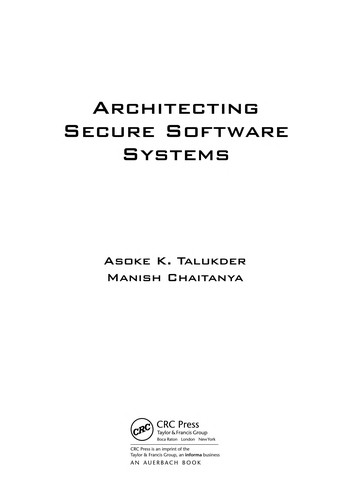
Architecting Secure Software Systems
0
0
As an Amazon Associate and affiliate partner, Menrva Books earns from qualifying purchases. Learn more
Author Description
Traditionally, software engineers have defined security as a non-functional requirement. As such, all too often it is only considered as an afterthought, making software applications and services vulnerable to attacks. With the phenomenal growth in cybercrime, it has become imperative that security be an integral part of software engineering so that all software assets are protected and safe. Architecting Secure Software Systems defines how security should be incorporated into basic software engineering at the requirement analysis phase, continuing this sharp focus into security design, secured programming, security testing, and secured deployment. Outlines Protection Protocols for Numerous Applications Through the use of examples, this volume defines a myriad of security vulnerabilities and their resultant threats. It details how to do a security requirement analysis and outlines the security development lifecycle. The authors examine security architectures and threat countermeasures for UNIX,.NET, Java, mobile, and Web environments. Finally, they explore the security of telecommunications and other distributed services through Service Oriented Architecture (SOA). The book employs a versatile multi-platform approach that allows users to seamlessly integrate the material into their own programming paradigm regardless of their individual programming backgrounds. The text also provides real-world code snippets for experimentation. Define a Security Methodology from the Initial Phase of Development Almost all assets in our lives have a virtual presence and the convergence of computer information and telecommunications makes these assets accessible to everyone in the world. This volume enables developers, engineers, and architects to approach security in a holistic fashion at the beginning of the software development lifecycle. By securing these systems from the project’s inception, the monetary and personal privacy catastrophes caused by weak systems can potentially be
Menrva's Summary
THE THESIS
This book addresses the critical need to integrate security into the software engineering lifecycle from its inception. It argues that security, often treated as a non-functional afterthought, must be a core consideration from requirement analysis through design, programming, testing, and deployment to protect software assets from the growing threat of cybercrime. The authors provide a comprehensive framework for achieving this holistic security approach.
THE SCOPE MAP
- What You Will Find:
- Security integration across the software development lifecycle: requirement analysis, design, programming, testing, and deployment.
- Protection protocols for numerous applications and a myriad of security vulnerabilities and their resultant threats.
- Security requirement analysis and the security development lifecycle.
- Examination of security architectures and threat countermeasures for UNIX, .NET, Java, mobile, and Web environments.
- Exploration of telecommunications and distributed services security through Service Oriented Architecture (SOA).
- Real-world code snippets for experimentation.
- A versatile multi-platform approach adaptable to various programming backgrounds.
THE AUTHORITY PERSPECTIVE
The book is presented as a comprehensive guide for developers, engineers, and architects to embed security into software development from the initial phase. It aims to provide a holistic approach to securing virtual assets by detailing methodologies and outlining security development lifecycles. The inclusion of real-world code snippets and a multi-platform approach suggests a practical and adaptable resource for professionals across different programming paradigms.
Page Count:
446
Publication Date:
2008-01-01
ISBN-10:
1420087843
ISBN-13:
9781420087840
Non-Fiction
Science & Technology
Software Engineering
Information Security
Computer Science
Cybersecurity
Community Tags
Similar Books